
Read the label
Fragrance-free vs unscented: what the label means
What the two claims mean, where scent shows up on an ingredient list and what fragrance-free can’t promise.
On this page
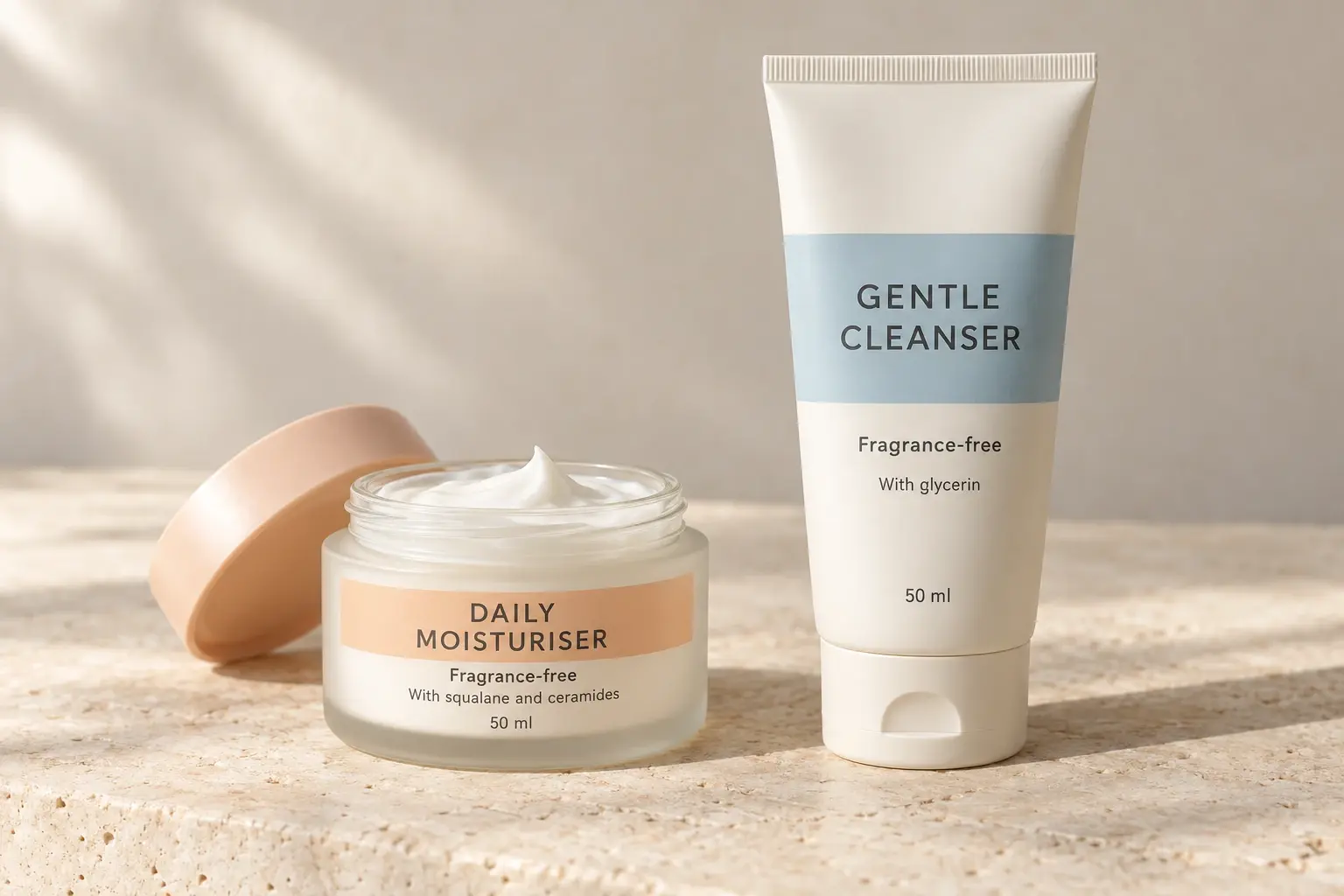
‘Unscented’, ‘fragrance-free’, ‘for sensitive skin’: the front of the pack can make several products look interchangeable when their ingredient lists aren’t. If fragrance has caused you problems before, the difference matters. This guide explains what the words mean, how to check the ingredient list for yourself in about a minute, and what even a genuine fragrance-free product can’t promise.
Clarity Summary
- Fragrance-free and unscented aren’t the same. An unscented product can contain fragrance used to mask the smell of the base.
- Check the ingredient list. Look for Parfum, named fragrance allergens and recognisable essential oils, then investigate anything unclear.
- A smell isn’t proof of added fragrance. Some base ingredients have their own scent.
- Fragrance-free removes one common trigger. It doesn’t remove every possible one.
Two words that sound alike
Fragrance-free should mean that no ingredients have been added to give the product a scent. Unscented describes how a product smells, not what’s in it. A product can smell of nothing because a masking fragrance has been added to cover the smell of the other ingredients.
That’s why the American Academy of Dermatology suggests choosing products labelled fragrance-free if fragrance is causing you problems. It advises caution with products labelled unscented, or containing plant-based botanical ingredients, because they may still contain fragrance-related ingredients (AAD, how to test skin care products; AAD, dry skin tips). Our fragrance page explains why fragrance is on our Red List in the first place.
How claims on the pack are policed
In Great Britain and Northern Ireland, cosmetic claims mustn’t suggest a product has a characteristic it doesn’t have, and they must meet six binding common criteria, including truthfulness, evidential support and honesty (GOV.UK, Great Britain; Northern Ireland). A separate European technical document explains how to apply those criteria to ‘free from’ claims; it’s guidance rather than law (CTPA).
So a fragrance-free claim should be truthful and supportable. The part you can check for yourself is the ingredient list.
Three places scent shows up on a label
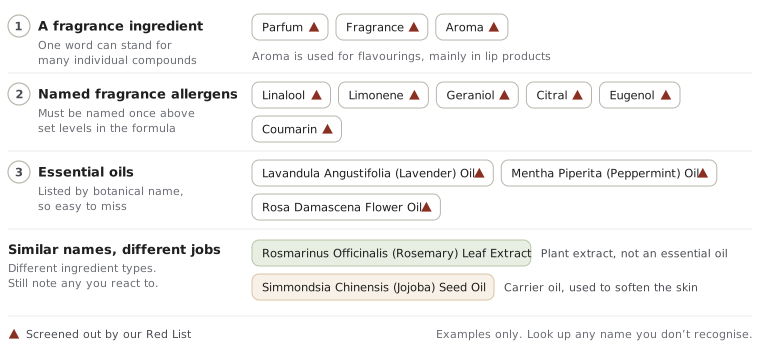
When you read an ingredient list, scent can appear in three ways:
- A fragrance ingredient. A scent blend appears as a single word, usually Parfum, sometimes Fragrance, or Aroma for flavourings in lip products. One word can stand for many individual compounds.
- Named fragrance allergens. In Great Britain, certain fragrance allergens must be listed by name once they go above 0.001% in leave-on products or 0.01% in rinse-off products. Examples are Linalool, Limonene, Geraniol, Citral, Eugenol and Coumarin (Regulation 1223/2009, Annex III, as it applies in Great Britain). Below those levels they don’t have to be named, so a list without them isn’t proof of zero exposure. Some, such as Benzyl Alcohol, can also do other jobs in a formula, so a named allergen doesn’t always tell you why it’s there. What it does tell you is that a substance a fragrance-allergic person may need to avoid is present.
- Essential oils. These are listed by their botanical names, which makes them easy to miss. Examples include Lavandula Angustifolia (Lavender) Oil, Mentha Piperita (Peppermint) Oil and Rosa Damascena Flower Oil. An essential oil used for scent is fragrance, however natural it sounds. Carrier oils are named in a similar way, such as Prunus Amygdalus Dulcis (Sweet Almond) Oil or Simmondsia Chinensis (Jojoba) Seed Oil, but they’re used to soften the skin rather than to scent it. If you don’t recognise an oil, look it up before you buy.
Where scent shows up on a label
Northern Ireland follows the EU rules, which have expanded the list of allergens that must be named. Products placed on the market after 31 July 2026 must use the longer list, while products already on sale can stay available until 31 July 2028 (Regulation (EU) 2023/1545; European Commission). Packs sold in both the UK and the EU may also show the longer list, so you may see older and newer labels side by side.
A list with none of the three is a much stronger signal than any word on the front of the pack.
A smell isn’t always added fragrance
A product can have its own faint smell without any added fragrance. Oils, butters, oat and other base ingredients all have a scent of their own. A fragrance-free formula isn’t required to smell of nothing.
The reverse matters too. Not every plant extract is a fragrance ingredient. A leaf extract used for its effect on the skin is different from an essential oil added to make the product smell nice. That’s why the list, not the smell, is the better guide. If a product with a long list of botanicals also names fragrance allergens near the end, those are substances to note if you’re fragrance-allergic, whatever their purpose in the formula.
Two quick label checks
A fragrance-free claim that the list supports. Skin Rocks The Cream Cleanser — Fragrance Free carries the claim in its name. Its list has no Parfum, no named fragrance allergens and no essential oils. It does include Rosmarinus Officinalis (Rosemary) Leaf Extract near the end. That’s a leaf extract, not rosemary essential oil, and the formula passed our fragrance screen. A plant extract isn’t automatically free of allergy risk, though, so if you’ve reacted to rosemary before, it’s still worth noting.
A fragranced formula you might not notice. The brightening serum in our ingredient-list guide ends its list with Linalool, Geraniol, Limonene and Parfum / Fragrance. Even if it doesn’t smell strongly, that list tells you fragrance is part of the formula.
What fragrance-free can’t tell you
Fragrance is one of the most common causes of cosmetic allergy, but it isn’t the only one. A fragrance-free product can still contain something your skin doesn’t tolerate: a preservative, a plant extract or another ingredient you’ve reacted to before. If you react to products repeatedly and can’t find a pattern, a GP can refer you for patch testing at a dermatology clinic, which looks for specific contact allergies (British Association of Dermatologists, patch testing).
Every product in our catalogue has passed our own fragrance screen: no Parfum, no declared fragrance allergens and no essential oils. That’s our curation rule, not a legal definition of fragrance-free, and it removes one common trigger rather than every possible one. Our screened moisturisers and cleansers show the results.
Your 60-second label check
- Ignore the front of the pack and turn to the full ingredient list.
- Is Parfum, Fragrance or Aroma listed?
- Are any named fragrance allergens listed, such as Linalool, Limonene, Geraniol, Citral, Eugenol or Coumarin? They’re often near the end.
- Are there any essential oils, such as lavender, peppermint or rose oil, listed by their botanical names? Look up any oil you don’t recognise.
- Is there anything else on the list you know you react to?
Sources
- American Academy of Dermatology. How to test skin care products. Updated 10 August 2021.
- American Academy of Dermatology. Dermatologists’ top tips for relieving dry skin. Updated 2 January 2026.
- GOV.UK. Regulation 1223/2009 and the Cosmetic Products Enforcement Regulations 2013: Great Britain. Updated 29 June 2026.
- GOV.UK. Regulation 1223/2009 and the Cosmetic Products Enforcement Regulations 2013: Northern Ireland. Updated 29 June 2026.
- Cosmetic, Toiletry and Perfumery Association. Cosmetic claims: focus on ‘free from’ claims. Published 3 July 2019, updated 6 December 2019.
- Regulation (EC) No 1223/2009 on cosmetic products, Annex III, as it applies in Great Britain. legislation.gov.uk. Used for the fragrance-allergen labelling thresholds.
- Commission Regulation (EU) 2023/1545 on the labelling of fragrance allergens in cosmetic products. EUR-Lex.
- European Commission. Fragrance allergens labelling.
- British Association of Dermatologists. Patch testing. Leaflet updated July 2024.
- Product ingredient list rechecked 22 October 2026: Skin Rocks The Cream Cleanser — Fragrance Free, Skin Rocks.
Product ingredient lists come from the linked Skincare Clarity assessments.