
Fragrance / Parfum
One of the most common cosmetic triggers for reactive skin — and one of the hardest categories to audit on a label.
Fragrance is one of the most consistently identified triggers in cosmetic contact dermatitis, and one of the first categories worth removing when reactive skin is difficult to stabilise. For non-reactive skin, scented products are usually fine. For skin that is currently in a flare or has become unpredictable — reacting to products it never used to react to — fragrance is the variable most worth eliminating first.
On this page
The Red List Verdict
Fragrance is on the Skincare Clarity Red List because it is consistently identified across patch-testing studies as one of the most frequent triggers of irritant and allergic reactions in cosmetic dermatology. Under retained UK and EU labelling rules, the single word Parfum can stand in for anywhere from a handful to several dozen individual aroma chemicals — many of which are known sensitisers. For a site built around an INCI-first audit, that opacity is the problem: you cannot screen what you cannot see.
The exclusion is comprehensive. It covers Parfum, Fragrance, Aroma, the declared fragrance allergens listed under UK and EU cosmetic regulations, and essential oils used at fragrance-level concentrations, regardless of whether the source is synthetic or natural.
What is fragrance?
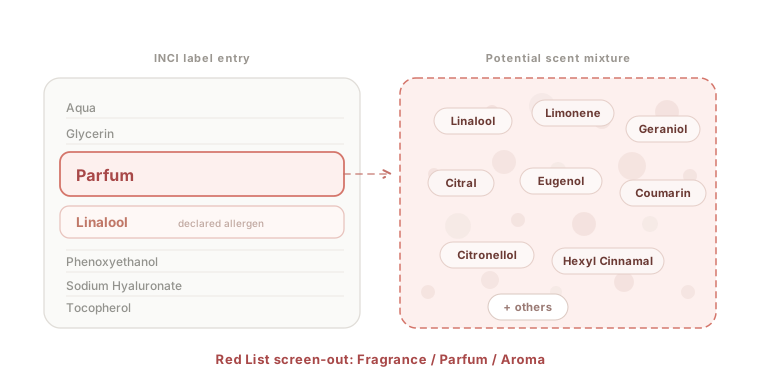
On a UK INCI list, scent is usually labelled as Parfum. The related term Aroma is used for flavouring agents in lip products and oral care. The US-style term Fragrance may also appear on imported or internationally labelled products. All three terms point to the same functional idea: a blended mixture of aromatic compounds added to a product to create scent or to mask the smell of the underlying formula. A single fragrance ingredient can contain dozens of individual aroma chemicals, and manufacturers are not required to disclose each one separately.
What they are required to disclose, under UK cosmetic regulations, is a defined list of fragrance allergens known to be common sensitisers — but only when present above small thresholds (0.001% in leave-on products, 0.01% in rinse-off). These declared allergens include Linalool, Limonene, Geraniol, Citral, and Eugenol, among others, and appear on the INCI as separate line items below the Parfum entry. The EU significantly expanded this list in 2023, with a two-stage transition: non-compliant products may be placed on the EU market only until 31 July 2026 and made available only until 31 July 2028. Great Britain has not automatically mirrored that expansion, but UK-sold products from brands also active in the EU may increasingly be labelled to the wider EU list.
Fragrance can be synthetic or naturally derived, and the source does not change how reactive skin tends to respond. Essential oils — lavender, rose, citrus, peppermint — are themselves fragrance ingredients, and they contain many of the same allergenic compounds as synthetic fragrance blends. A formula scented with essential oils only is not a fragrance-free formula.
Fragrance / Parfum as a hidden scent category
Why fragrance is on our Red List
Patch-testing studies consistently identify fragrance as one of the most frequent triggers of cosmetic-induced contact dermatitis. For users with normal, non-reactive skin, this rarely translates into a noticeable problem — many people use fragranced products their whole lives without issue. For reactive or compromised skin, the threshold for reaction is lower, and fragrance allergens are among the most common things that cross it.
The second issue is one of transparency. The point of an INCI-first audit is being able to see exactly what is in a formula and judge it on that basis. A line item that says only ‘Parfum’ defeats that audit — it could represent a single nature-identical molecule or a blend of forty compounds, and the consumer has no way of knowing which.
The third issue is functional. Fragrance does no work for the skin. It exists to make a product feel more pleasant to use. For most product categories that is a fair trade. For a curation framework built around reactive skin, where every ingredient should be earning its place, a known common irritant added purely for sensory reasons does not pass the screen.
What to look for on a label
On a UK INCI list, fragrance shows up under several names:
- Parfum — the most common term, used for blended fragrance compositions
- Fragrance — the US-style equivalent, sometimes seen on imported products
- Aroma — used for flavouring agents in lip products and oral care
The declared fragrance allergens that may appear as separate line items include Linalool, Limonene, Geraniol, Citral, Eugenol, Coumarin, Citronellol, Hexyl Cinnamal, Benzyl Salicylate, Benzyl Benzoate, and Cinnamyl Alcohol, among others. These can occasionally appear in products labelled fragrance-free where they have been added for non-fragrance technical reasons, but in practice their presence almost always signals added scent.
Watch also for essential oils functioning as fragrance. These are usually listed on the INCI by botanical Latin name, which can make them harder to spot than a clear Parfum line: Lavandula Angustifolia (Lavender) Oil, Rosa Damascena (Rose) Flower Oil, Mentha Piperita (Peppermint) Oil, Citrus Aurantium Bergamia (Bergamot) Oil, and similar.
Be aware that ‘unscented’ is not the same as ‘fragrance-free’. Some unscented products use masking fragrances to neutralise the smell of the base, and those masking compounds can themselves contain allergens. The reliable signal is an INCI list with no Parfum, no Fragrance, no Aroma, no declared allergens, and no recognisable essential oils — not a marketing claim on the front of the bottle.
What to use instead
For reactive skin, the goal is a formula that is genuinely fragrance-free in every sense — synthetic, natural, and masking included.
The strongest signal that a fragrance-free product was built thoughtfully is what fills the formula in place of scent. Look for barrier-supporting ingredients like ceramides, glycerin, panthenol, and squalane, and calming ingredients like Oat Family extracts, Cica Family compounds, bisabolol, or allantoin. These suggest a formula built around skin function rather than sensory experience.