
Glycerin
The hydration ingredient your barrier is probably already missing.
If your skin still feels tight after a gentle cleanser, or dry and a little raw by the middle of the day despite a full routine, dehydration is usually the first place to look. Not the dramatic, flaking kind — just a quiet, persistent water shortage in the outer barrier that makes the skin feel less comfortable than it should. Glycerin is usually where that fix starts.
On this page
The Clarity Summary
Glycerin is the dependable baseline hydrator of barrier-first skincare. It is not a trending ingredient and it does not have a compelling origin story, but it appears in more well-built sensitive-skin formulas than almost anything else — and there is a straightforward reason for that. For reactive skin, glycerin matters because it helps the barrier hold onto water in a way that feels reliable, low-drama, and easy to tolerate.
For Skincare Clarity, glycerin is not valuable because it is flashy. It is valuable because it quietly improves the feel of the skin day after day, especially when the face feels tight after cleansing, dry in central heating, or generally less comfortable than it should.
What is glycerin?
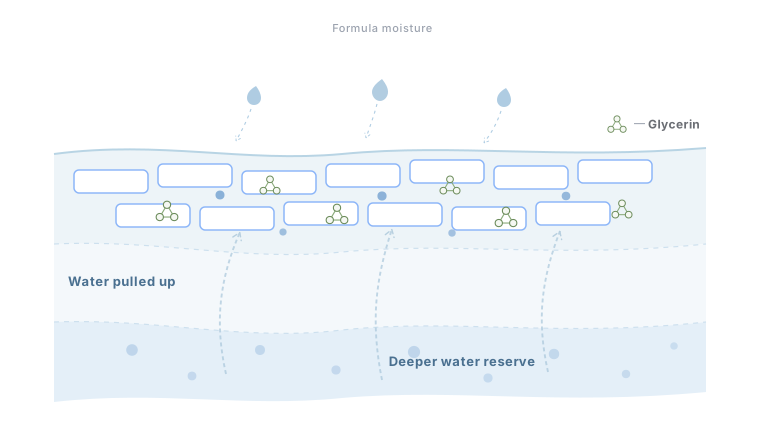
Glycerin — also listed as glycerol on INCI labels — is a humectant: an ingredient that helps bind water in the upper layers of the skin and helps it stay there. It occurs naturally in the body, remains highly stable in formulas, and is one of the most widely used and generally well-tolerated humectants across skin types, including sensitive and reactive skin. Its job is to keep the outer barrier properly hydrated so the skin feels less tight, less stiff, and less likely to overreact through the day.
The role is simple, but that simplicity is part of its strength. Glycerin does not try to coat the skin like a rich butter, and it does not rebuild the barrier structure like ceramides. Instead, it improves the water balance of the outer barrier so the skin feels less papery, less exposed, and generally more comfortable.
This is why glycerin appears in so many of the formulas that reactive skin tends to tolerate well. When the barrier is dry, the skin often becomes more reactive as well. Glycerin helps address that water gap directly, which is one reason it remains such a reliable foundation ingredient — not a trend, but a cornerstone of dermatology-led skincare for decades.
Glycerin as a hydration humectant
Why glycerin matters for sensitive and reactive skin
Reactive and sensitive skin is not only easily irritated — it is often chronically a little dry, even when it does not look it. The outer barrier needs a certain level of water to function well, and when that level drops, the skin becomes easier to aggravate: more reactive to temperature, more sensitive to products it would normally tolerate, quicker to feel uncomfortable.
Glycerin addresses that water gap directly. Think of it less as a treatment and more as a baseline condition your skin needs to be in before anything else can do its job properly.
Glycerin is especially useful when skin feels:
- tight or stripped after cleansing — even after a gentle wash
- uncomfortable in air conditioning or central heating
- easily aggravated during colder months
- oily yet also dehydrated — a surprisingly common combination
1. The hydration baseline many routines are missing
Some ingredients are useful in very specific scenarios. Glycerin is useful in almost all of them. It helps improve hydration in the upper barrier so the skin feels softer, more flexible, and less ‘pulled’ through the day.
That matters because many reactive-skin problems are made worse when the barrier is simply too dry. The skin may not need a stronger active. It may need a better hydration base.
2. Strong support for post-cleansing comfort
One of glycerin’s most practical benefits is what it does after washing. A cleanser can be gentle on paper, but if the skin still feels tight afterwards, the routine is not really working hard enough for a sensitive barrier. Glycerin helps reduce that post-wash discomfort and makes the whole routine easier to tolerate.
3. Works across almost every product category
Some ingredients are best kept to serums or richer creams. Glycerin is useful across cleansers, serums, moisturisers, and recovery treatments. That flexibility makes it one of the strongest ‘good judgement’ signals on an INCI list. It also works particularly well alongside ceramides, squalane, and panthenol, because those ingredients support the barrier from different angles. Glycerin handles the water side of the equation.
What glycerin cannot do
Glycerin is a humectant, which means it helps bind water in the stratum corneum — the outer barrier — and improves the way that layer holds moisture. In very dry conditions, it works best inside a complete moisturiser or layered under an emollient or occlusive, rather than used alone as a thin humectant step.
In practice, this is rarely a problem when glycerin appears inside a moisturiser or a formula that also contains emollients or occlusives. But it is worth knowing when you are layering a standalone glycerin serum in cold, dry conditions. The solution is simple: follow it with something that seals — a cream, a lipid-rich moisturiser, or an emollient like squalane.
Glycerin also cannot replace the lipid side of barrier repair. It keeps the water in balance; it does not rebuild the structure. If your barrier is significantly compromised, you will need ceramides and emollients alongside glycerin, not instead of it.
Is glycerin good for sensitive skin? The Clarity Verdict
Glycerin is a foundational Green List ingredient and one of the most trustworthy hydration signals in the entire library. We value it because it makes sensitive skin feel more comfortable in a way that is practical, repeatable, and rarely overcomplicated.
If ceramides help hold the barrier together, glycerin helps make sure there is enough water in the system for that barrier to function properly. That is why we look for it so often in the products most suited to reactive, dryness-prone skin — not as the star ingredient, but as the quiet foundation underneath everything else.
How to use glycerin
Best For
- Dehydrated skin
- Tight after cleansing
- Reactive dry phases
- Oily-dehydrated skin
Use When
- Morning and night
- On slightly damp skin
- After cleansing
- In barrier-repair routines
Products featuring glycerin
Our ingredient-led product recommendations are being prepared and will be added soon.