
The Ceramide Family
Barrier-supporting lipids for dry, reactive, and easily compromised skin.
If your skin feels tight no matter how much moisturiser you apply, stings when you use products that never used to bother you, or seems to react to almost everything during certain seasons, the outer barrier is likely asking for structural help. Hydration alone will not fix a barrier that has lost its lipid integrity. Ceramides are where that repair begins.
On this page
The Clarity Summary
Ceramides are one of the most important barrier-support ingredients in skincare. They are naturally found in the outermost layer of the skin and help keep that barrier strong, flexible, and less prone to water loss. For sensitive and reactive skin, ceramides matter because they support a healthier barrier — and a healthier barrier is less likely to feel tight, dry, or easily irritated.
For Skincare Clarity, ceramides are the clearest example of an ingredient that does genuine structural work. They are not a quick-fix hydrator and they are not a calming ingredient. They rebuild the lipid scaffolding that keeps reactive skin functional over the long term.
What are ceramides?
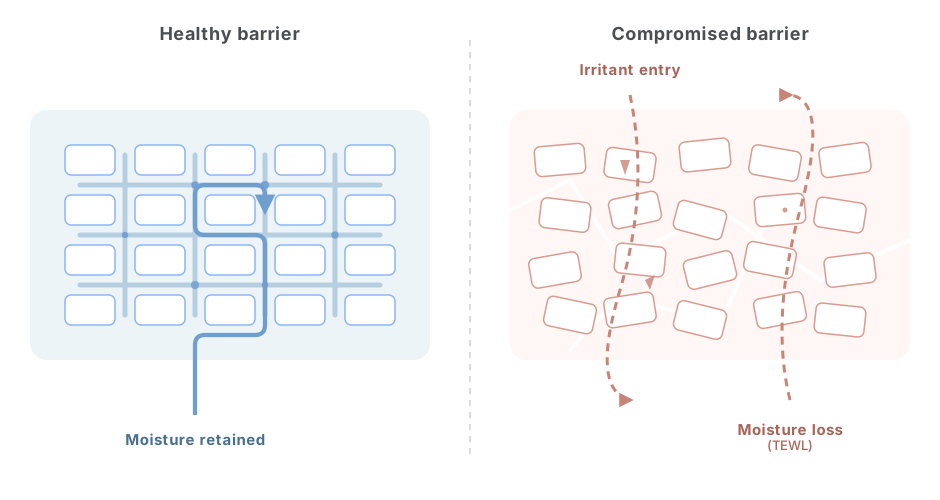
Ceramides are a family of lipid molecules that make up a significant portion of the outermost layer of the skin — the stratum corneum. They sit between skin cells, holding the structure together and preventing water from escaping too quickly. A useful way to picture this is the classic ‘bricks and mortar’ model of the skin barrier: the skin cells are the bricks, and ceramides (along with cholesterol and fatty acids) are the mortar that holds everything in place.
When ceramide levels are low, the skin barrier becomes more vulnerable to:
- Transepidermal water loss (TEWL) — moisture escapes more easily, leaving skin dry or tight
- Barrier weakness — the skin may feel less resilient and more reactive to everyday triggers such as weather, heating, cleansing, or overuse of actives
Ceramides are not a trend or a marketing invention. They are one of the most clinically well-supported ingredients in modern dermatology, and the reason you see them in so many barrier-repair products is that the underlying science is strong.
Ceramides as barrier ‘mortar’
The Ceramide Family: NP, AP, EOP
On an INCI list, ceramides usually appear as specific subtypes rather than as a single generic term. High-performance formulas often use more than one type to better support the skin barrier. The three you will see most often are:
- Ceramide NP — one of the most common ceramides in skincare. It is widely used to support barrier strength and help reduce moisture loss
- Ceramide AP — often included as part of a broader ceramide blend. It contributes to barrier maintenance and helps support a smoother-feeling skin surface
- Ceramide EOP — a ceramide often associated with structural support in the lipid matrix. In well-designed formulas, it helps the overall barrier system feel more cohesive
Hydroxypropyl Bispalmitamide MEA is a ceramide-analogue that behaves similarly on the skin.
Older product literature may also use numbered names such as Ceramide 3 or Ceramide 6-II. These belong to an older naming system, and some have since been replaced by newer letter-code INCI names — for example, Ceramide NP is the current INCI name for what older labels called Ceramide 3. Because the numbered system does not map neatly onto every modern label, it is best to treat numbered and letter-code names as naming variants rather than as a separate, additional set of ceramides.
Seeing two or three of these together in a formula is usually a good sign. It indicates the product is built to support the barrier through multiple ceramide types rather than relying on a single variant.
Why ceramides matter for sensitive and reactive skin
Ceramides are especially relevant when skin feels dry, tight, over-cleansed, over-exfoliated, or more reactive than usual. They are not a quick fix — in the way a soothing serum or cooling gel might be in the moment. Their value is foundational. They help improve the skin’s ability to hold onto moisture and function more like a healthy barrier.
1. Less ‘stinging’ and tightness
When the barrier feels compromised, even simple routines can become uncomfortable. Ceramide-rich products can help make the skin feel more supported and less exposed — particularly after stronger actives, or during seasonal stress.
2. Better day-to-day resilience
Reactive skin often shifts between calmer and more difficult phases. Ceramides help support the kind of barrier strength that makes those swings less dramatic over time.
3. Longer-lasting hydration
Humectants like glycerin or hyaluronic acid help bring water into the upper layers of the skin. Ceramides help reduce the chance of that water escaping too quickly. The two roles are complementary, not interchangeable — and a well-built formula usually pairs them together.
The barrier-lipid system
Ceramides work best as part of a wider system. One of the most useful things to know about ceramides is that they are often most effective when combined with two other lipids: cholesterol and fatty acids.
This is why we often look for formulas that also include cholesterol, phytosphingosine, and fatty acids, rather than treating them as a standalone ingredient.
Science highlight: the ‘golden ratio’ idea
Barrier-recovery research often points towards the importance of combining ceramides + cholesterol + fatty acids in a balanced formula. It is simply that better-formulated barrier products tend to use these lipids in a balanced way, rather than overloading one lipid in isolation. This is why Skincare Clarity pays close attention to the presence of cholesterol and phytosphingosine in better-focused products.
What this means in practice: a product that contains ceramides alongside these partner lipids is usually a more complete barrier-repair formula than one relying on ceramides alone. The ‘golden ratio’ is a useful marker, not a magic formula — but it is a strong signal worth recognising.
Formulation quality matters more than origin
This is worth being straightforward about, because the ‘natural is always better’ assumption often works against reactive skin here.
Most ceramides used in skincare are made by bio-identical synthetic processes rather than extracted from plant or animal sources. At Skincare Clarity, we are comfortable with well-formulated synthetic or plant-derived ceramides because they are stable, consistent, highly purified, and well suited to sensitive skin. For this category, purity and stability matter more than marketing language.
The honest picture:
- Synthetic ceramides are manufactured to match the structure of the ceramides naturally found in human skin. They are highly stable, consistent from batch to batch, and do not carry the contamination concerns that can sometimes affect raw plant extracts.
- Plant-derived ceramides (often from rice, wheat, or konjac) can also be effective, particularly in some well-formulated products. But the concentration of active ceramides in raw plant material is typically much lower than in synthetically produced equivalents.
- Animal-derived ceramides are increasingly rare and are not something we look for on an INCI list.
For reactive skin specifically, we would rather see a clearly formulated ceramide blend — synthetic or plant-derived — than a vague ‘natural ceramide complex’ with unclear concentration. This is one of the areas where what matters is formulation quality and known concentration, not whether a ceramide is labelled natural or synthetic — and we think being honest about that serves readers better than assuming ‘natural is automatically cleaner’.
What ceramides cannot do
Ceramides are foundational, but they are not a complete routine. A few limitations are worth understanding.
Ceramides cannot rebuild a barrier overnight. Barrier recovery is a process measured in weeks, not days. You may feel some comfort improvement quickly, but the structural change takes longer. Consistency matters more than intensity — a well-formulated ceramide moisturiser used daily will outperform a single ‘rescue’ product used occasionally.
Ceramides alone are not enough if the rest of the routine is stripping the barrier. If you are cleansing with a harsh surfactant, layering actives without recovery time, or using fragranced products that aggravate the skin, no amount of ceramide support will keep up with the damage. Ceramides work best when the broader routine is already calm.
Ceramides do not calm active inflammation. They are structural, not soothing. If the skin is actively red, stinging, or inflamed, a ceramide moisturiser will help support the barrier underneath but will not directly reduce the inflammation. For that, ingredients like centella, oat, or panthenol are more relevant.
And finally, ceramides are often marketed as a complete solution, which they are not. The best barrier-repair formulas combine ceramides with cholesterol, fatty acids, humectants, and emollients. A product that lists ceramides prominently but contains little else doing structural work is often underperforming.
Are ceramides good for sensitive skin? The Clarity Verdict
Ceramides are a foundational Green List ingredient and one of the strongest signals of a barrier-first formula. We prioritise ceramides most heavily in moisturisers, recovery treatments, and selected serums. They are also a welcome bonus in cleansers, especially when a formula is designed to reduce the stripped feeling that can follow washing.
If a product is aimed at dry, reactive, or easily compromised skin, seeing ceramides on the INCI list is usually a very positive sign. They are not a quick fix and they are not glamorous, but they are the closest thing skincare has to genuine structural support for a compromised barrier — and for many reactive-skin users, no other ingredient makes a bigger long-term difference.
How to use ceramides
Best For
- Dry and tight skin
- Reactive skin phases
- Barrier-compromised skin
- Over-exfoliated skin
Use When
- Morning and/or night
- During dry weather
- Irritation-prone phases
- When using stronger actives
Products featuring ceramides
Our ingredient-led product recommendations are being prepared and will be added soon.