
The Cica Family
A family of plant-derived compounds with a strong track record for calming reactive, stressed, and recovering skin.
Some skincare ingredients are calming in the vague way marketing uses the word — ‘calming essence’, ‘calming toner’, ‘calming moisturiser’ — where the claim is more comforting than measurable. Cica is one of the few where that language is actually backed by a serious evidence base. For reactive skin that has learned to be sceptical of soothing claims, understanding what cica does — and what still belongs to marketing rather than research — is worth the time.
On this page
The Clarity Summary
Cica is one of the most clinically substantiated comfort ingredients in modern skincare — a family of compounds derived from the Centella asiatica plant that have been studied for decades in dermatological contexts, including post-procedure recovery, compromised barriers, and inflammation-prone skin. It became a Western skincare staple through the rise of Korean beauty, but its roots are much older: traditional use stretches back centuries across several regions of Asia.
For Skincare Clarity, cica is a Green List hero in the Soothing Superstars category. Its presence on an INCI list is one of the strongest comfort signals we look for, particularly in serums, recovery balms, and formulas aimed at reactive or post-stress skin.
What is cica?
‘Cica’ is the common shorthand for ingredients derived from Centella asiatica, a small plant native to the wetlands of Asia — also known as gotu kola or tiger grass. The name ‘cica’ itself is a marketing abbreviation, popularised by Korean skincare and now used interchangeably with centella asiatica across the industry. Traditional systems of medicine across India, China, and parts of Southeast Asia have used centella for centuries for skin comfort and recovery; its arrival in modern Western skincare is comparatively recent.
What makes cica an interesting ingredient is that it is not a single compound. The plant contains several active constituents — a group of naturally occurring molecules called triterpenes — each of which plays a slightly different role on the skin. When you see ‘cica’, ‘centella’, or ‘tiger grass’ on a label, you are usually looking at either a full extract of the plant or a formula built around one or more of these specific triterpenes.
The research base for cica is unusually strong for a plant-derived ingredient. It has been studied in the context of post-procedure recovery, barrier-compromised skin, and inflammation-prone conditions — not at the level of pharmaceutical drugs, but well beyond most ‘calming’ botanicals, where the evidence often stops at tradition and anecdote.
Cica Family as botanical comfort support
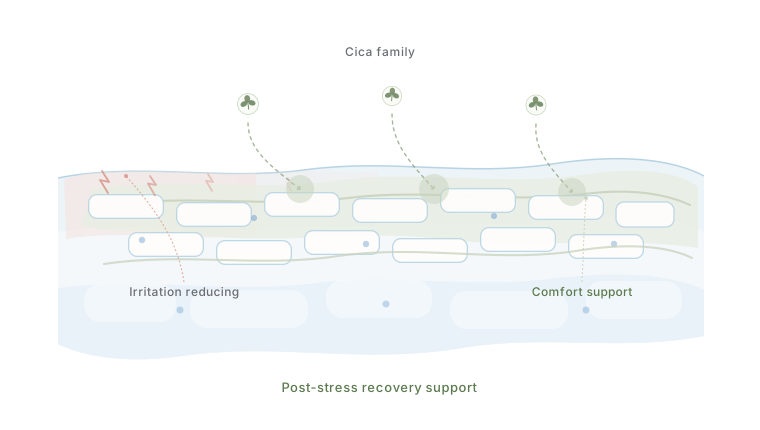
The Cica Family
When you see cica on a label, it is worth knowing which version of the ingredient is actually present. The five names you are most likely to encounter are:
- Centella Asiatica Extract — the full plant extract, containing a mix of the active compounds below along with other naturally occurring components. The most common form in everyday skincare.
- Madecassoside — one of the specific triterpenes isolated from centella. Widely studied in the context of skin recovery and comfort, and often called out prominently on labels because of its research profile. Frequently appears in recovery-focused serums and balms.
- Asiaticoside — another isolated triterpene, closely related to madecassoside. Associated with comfort support and often paired with madecassoside in more technical formulations.
- Asiatic Acid — a related triterpene acid. Less commonly listed on its own, but present in full extracts and sometimes included in targeted recovery products.
- Madecassic Acid — another triterpene acid, structurally related to asiatic acid. Like asiatic acid, more common as part of a broader centella extract than as a standalone listed ingredient.
Common names on labels: Centella Asiatica Extract, Centella Asiatica Leaf Extract, Madecassoside, Asiaticoside, Asiatic Acid, Madecassic Acid, TECA (Titrated Extract of Centella Asiatica — a standardised concentrate combining the key compounds), Tiger Grass, and simply ‘Cica’.
Seeing two or three of these together — particularly an extract plus one or two isolated triterpenes — usually indicates a formula that has been built with cica as a genuine active rather than as a marketing inclusion.
Why cica matters for sensitive and reactive skin
Reactive skin frequently needs comfort support that goes beyond hydration. Humectants and lipids address the water and structural sides of the barrier. Cica addresses something different: it helps the skin feel less reactive, less warm, and less distressed during the phases when those problems are front-and-centre. That is a different job from what ceramides or glycerin do, and it is the territory where cica proves why it matters so much for reactive skin.
Cica is especially relevant when skin feels:
- warm, flushed, or visibly red during a reactive phase
- post-procedure (peels, lasers, microneedling, extractions)
- inflamed around blemishes rather than just where they are
- stressed by environmental exposure — wind, cold, pollution, UV
- overwhelmed after trying too many actives in sequence
The strongest scenario for cica is post-stress recovery. This is where its evidence base is clearest and its practical value most noticeable. If the skin has been aggravated — by a procedure, by a reaction, by weather, or by a stretch of too-much-too-fast with actives — cica in a well-formulated product can be one of the more credible ingredients for helping the skin feel more settled, often on a shorter timescale than slower barrier-repair ingredients.
It also suits long-term sensitive-skin routines, not just flare management. For readers whose skin is chronically reactive, small amounts of cica distributed across a routine — in a serum, a moisturiser, or an SPF — can raise the general comfort level of daily skincare. This is less dramatic than post-stress recovery but arguably more valuable over time.
Cica pairs naturally with panthenol for comfort, with ceramides for barrier support, and with ectoin for environmental stress protection. The four together are the backbone of most serious reactive-skin recovery formulas.
How cica fits with oats and ectoin
Cica is not the only foundational comfort ingredient in the Skincare Clarity library. Alongside it sit two others: the Oat Family and ectoin. The three are often grouped together as ‘calming’ ingredients, but they do slightly different jobs in a routine.
Where cica is best known for acute and post-stress recovery, oats tend to work more cumulatively for chronically reactive, itch-prone skin, and ectoin addresses a different territory altogether — the environmental load of modern urban life. A well-built reactive-skin routine often includes more than one of them.
What to look for on a label
For reactive-skin readers specifically, a few practical reading notes help separate genuine cica formulas from decorative ones.
Look for isolated triterpenes, not just the extract. A product listing madecassoside or asiaticoside alongside the broader centella extract is usually built with more intent than one listing the extract alone. Not always — a well-made extract can still be effective — but the isolated compounds are a strong positive signal.
Position on the INCI list matters. Cica in the top half of a short ingredient list is doing real work. Cica listed near the end of a long formula is more likely a marketing inclusion. This is the same principle that applies to most ingredients, but it is worth repeating for cica specifically because the word carries strong shelf appeal.
Be wary of ‘cica-inspired’ or ‘cica-feel’ formulas that do not actually contain centella. A few products use the word in their marketing without meaningful amounts of the ingredient in the formula. Checking the INCI list is the simplest way to confirm.
What cica cannot do
Cica is one of the best-supported soothing ingredients available, but honest expectations matter.
It is not a treatment for chronic inflammatory conditions. Cica can make rosacea-prone or eczema-prone skin feel more comfortable and is often included in products aimed at those skin types — but it is a comfort support, not a therapeutic treatment. For diagnosed inflammatory conditions, a dermatologist-led approach remains more appropriate than relying on a botanical soothing ingredient, however well-supported.
It cannot repair a compromised barrier on its own. Cica’s strength is in the calming and recovery space, not in structural barrier rebuilding. If the barrier is damaged, cica should sit alongside barrier ingredients — ceramides, cholesterol, fatty acids — not in place of them. The best recovery formulas combine the two categories rather than relying on one.
‘Cica’ and ‘centella’ are not always equal. Products that list only ‘Cica’ or ‘Tiger Grass’ without a specific INCI name are slightly harder to evaluate. The marketing term often signals a centella extract, but the concentration and quality can vary considerably between products. Look for the formal INCI listings — Centella Asiatica Extract, Madecassoside, Asiaticoside — for a clearer read of what is actually in the formula.
And finally, while cica is more research-backed than most botanical soothing ingredients, the evidence base is still below that of pharmaceutical-grade active ingredients. For mild-to-moderate comfort needs, it is one of the strongest choices available. For severe, persistent, or medically-driven skin issues, it is a helpful addition to a routine rather than a primary solution.
Is cica good for sensitive skin? The Clarity Verdict
Cica is a foundational Green List ingredient and the hero of the Soothing Superstars category. We prioritise it most heavily in recovery serums, post-procedure balms, SPF formulas aimed at reactive skin, and moisturisers built for chronically sensitive routines.
If a product is aimed at calming, comforting, or supporting reactive skin, seeing cica on the INCI list — particularly alongside isolated triterpenes like madecassoside — is one of the strongest positive signals we look for. It is not glamorous, it is not a quick fix, but for the specific job it does, there are few ingredients with a comparable combination of traditional use, modern research, and practical results.
How to use cica
Best For
- Reactive skin
- Red, stressed skin
- Post-treatment recovery
- Fragile barrier phases
Use When
- Morning and night
- During irritation phases
- After stronger actives
- In recovery routines
Products featuring cica
Our ingredient-led product recommendations are being prepared and will be added soon.