
Zinc oxide
The mineral sunscreen filter that offers broad-spectrum protection with the cleanest tolerance profile for reactive skin.
Daily SPF is one of those skincare habits that sounds easier than it is. Reactive skin often meets chemical sunscreens with stinging, redness, or breakouts — and the ‘minimal sunscreen for sensitive skin’ market is considerably smaller and more expensive than the mainstream alternative. For most readers who end up skipping SPF, it is not a discipline problem. It is a tolerance problem. Zinc oxide is why that problem has a solution at all — and for reactive skin, it is the most important ingredient in daily UV protection.
On this page
The Clarity Summary
Zinc oxide is a mineral sunscreen filter that offers broad-spectrum UVA and UVB protection through a physical and spectral-absorbing mechanism — sitting on or near the skin surface rather than being absorbed into deeper layers. Unlike chemical filters, which often trigger reactions in sensitive users, zinc oxide is one of the most consistently well-tolerated SPF ingredients available.
For Skincare Clarity, zinc oxide is the foundational SPF filter — the ingredient that makes daily sun protection accessible to reactive skin rather than a daily tolerance challenge. It is the most important ingredient in daily UV protection, and the reason the Skincare Clarity library is mineral-first in its SPF recommendations.
What is zinc oxide?
Zinc oxide is a mineral compound — a simple molecule of zinc and oxygen — that has been used as a topical skin protectant for decades, originally in medical and barrier-repair contexts (it is still the active ingredient in traditional nappy rash creams and barrier ointments) and more recently as a sunscreen filter in modern skincare.
On INCI lists it appears under several related forms. Zinc Oxide is the standard listing. Non-nano zinc oxide describes particles above 100 nanometres — the size that sits more visibly on the skin surface and does not penetrate. Nano zinc oxide describes smaller particles that produce a more cosmetically elegant finish. Coated zinc oxide refers to zinc oxide treated with a protective surface layer (often silica or a similar inert coating) to reduce potential interaction with other formula ingredients. All four are legitimate; the differences are formulation choices rather than meaningful performance differences for most users.
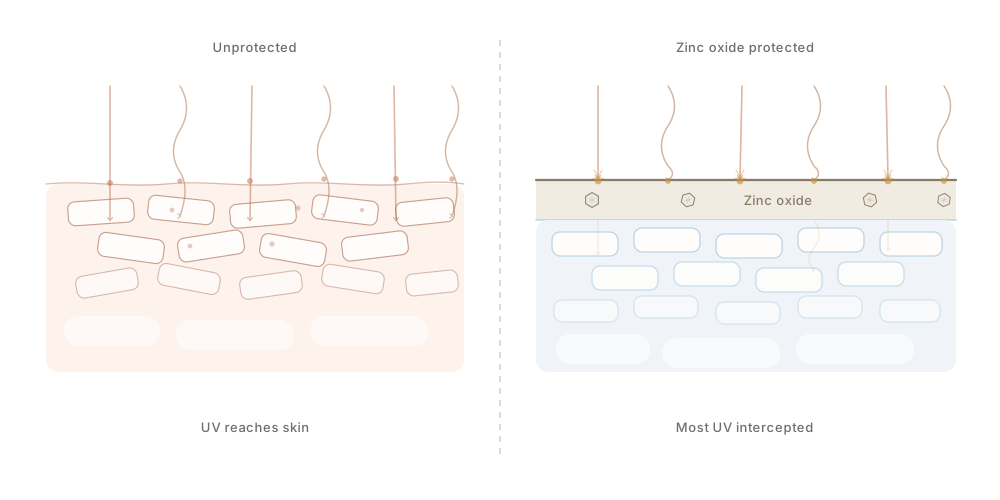
What makes zinc oxide distinctive among sunscreen filters is the breadth and reliability of its protection. It provides broad-spectrum coverage across both UVA (the longer wavelengths associated with ageing and cumulative damage) and UVB (the shorter wavelengths associated with burning and more acute damage) through two combined mechanisms: physical scattering of UV radiation and spectral absorption. Most chemical filters excel in one band and require combination to cover the full spectrum. Zinc oxide covers the full spectrum on its own.
The reliability matters. Mineral filters do not degrade under UV exposure in the way some chemical filters do, meaning a zinc oxide sunscreen avoids some of the photostability issues that affect certain organic filters. In practical terms, photostability is a formula advantage, not a licence to reapply less often: it means the filter itself is less prone to UV breakdown between normal reapplications.
Zinc oxide as broad-spectrum mineral protection
Why zinc oxide matters for sensitive and reactive skin
For reactive skin, SPF is simultaneously the most important skincare habit and often the hardest to maintain. Chemical filters — oxybenzone, octinoxate, avobenzone, and their relatives — frequently cause stinging, redness, or breakouts in sensitive users. The daily choice often comes down to wearing a sunscreen that actively irritates the skin or not wearing one at all, and neither serves reactive skin well.
Zinc oxide is especially relevant when skin:
- reacts to chemical sunscreens with stinging, warmth, or breakouts
- is in an actively reactive phase and cannot tolerate additional ingredient load
- is recovering from a barrier compromise and needs minimal daytime friction
- needs reliable daily SPF without the tolerance caveats of chemical alternatives
The strongest honest case for zinc oxide is that it makes daily SPF possible for reactive users in a way that chemical filters often do not. For readers whose skin has consistently rejected mainstream sunscreens, a well-formulated mineral sunscreen is frequently the point at which SPF stops being a daily challenge and becomes a simple routine step.
Zinc oxide also pairs unusually cleanly with the rest of a sensitive-skin routine. It works comfortably alongside niacinamide, the Vitamin C Defence System, and the barrier-supporting ingredients — ceramides, glycerin, panthenol. It does not interfere with retinoid-alternative actives at night or with calming ingredients during the day. For building a complete reactive-skin routine, mineral SPF is one of the least-conflicting components you can add.
The cosmetic trade-off, honestly
Zinc oxide’s advantages are real, but so is the cosmetic trade-off — and it is worth naming plainly rather than pretending it does not exist.
Mineral filters, including zinc oxide, tend to leave a faint white cast on the skin. This is most visible on deeper skin tones, where the cast can be unflattering, and least visible on lighter skin tones, where most modern formulations disappear almost entirely after a minute of settling. The cast is linked to the same particle behaviour that makes mineral filters visible on skin, but the relationship is not absolute: micronised, nano and coated forms can reduce visible cast while still providing UV protection.
Modern formulation has made considerable progress on this trade-off. Micronised and nano-particle zinc oxide, coated formulations, and tinted products (see iron oxides for the library’s take on tinted mineral SPF) all reduce the visible cast substantially. The best current mineral sunscreens, particularly those that combine zinc oxide with iron oxides for a tinted finish, are cosmetically elegant in ways that earlier mineral formulations were not.
For readers with deeper skin tones, the honest answer is that finding a cosmetically acceptable mineral SPF takes more effort than for lighter skin. The category has improved dramatically but still has meaningful gaps. Tinted mineral formulations are often the most reasonable path — a tinted SPF with zinc oxide as the primary filter typically outperforms both untinted mineral options (which show a white cast) and pure chemical filters (which produce tolerance issues) for sensitive users with deeper skin tones.
The separate and related question of chemical vs mineral filters more broadly is worth brief treatment. Chemical filters have real strengths — often more cosmetically elegant, sometimes higher overall protection in well-formulated products, and increasingly well-tolerated in newer modern formulations. For users whose skin accepts chemical filters without issue, they remain a legitimate choice. Skincare Clarity’s preference for mineral is driven by the target audience’s specific tolerance needs, not by a blanket claim that mineral is universally superior.
What it cannot do
Zinc oxide is excellent, but a few things are worth clarifying.
Higher concentration does not equal higher SPF rating. SPF is determined by the full formula, not by the zinc oxide percentage alone. A 20% zinc oxide formula can offer SPF 30 or SPF 50 depending on how the rest of the product is built. Marketing that foregrounds the zinc oxide percentage without naming the SPF rating is getting priorities backwards.
Mineral filters still need reapplication. There is a persistent misconception that because mineral filters are more photostable than some chemical filters, they need less frequent reapplication. This is not correct. Any SPF — mineral or chemical — needs reapplication every 2–3 hours of significant sun exposure, after swimming, or after heavy sweating. The better photostability means zinc oxide does not lose effectiveness between reapplications, not that reapplication is optional.
‘Physical’ is not quite the right word. Older explanations of how mineral filters work describe them as purely ‘physical barriers’ that reflect UV back into the atmosphere. This is a simplification — zinc oxide works through a combination of spectral absorption and some light scattering, with absorption doing most of the protective work. This is a minor technical point, but it matters for understanding the ingredient accurately: mineral filters are not like tinfoil or white paint, and the ‘physical sunscreen’ framing is a marketing shortcut rather than a scientific description.
And finally, zinc oxide is not a skincare active. It does not calm, hydrate, or treat the skin directly — it protects the skin from UV so that the rest of the routine can do its work. Some products combine zinc oxide with supporting ingredients (niacinamide, panthenol, and similar), and those can deliver both protective and comfort effects in a single product. But expecting the filter itself to do non-SPF skincare work is a misunderstanding of what zinc oxide is there for.
Is zinc oxide good for sensitive skin? The Clarity Verdict
Zinc oxide is a foundational Green List ingredient and the single most useful SPF filter for reactive, sensitive, and barrier-compromised skin. We prioritise it heavily in SPF recommendations across the library — almost every SPF product we consider seriously contains zinc oxide as either the primary filter or a substantial component of a mixed-mineral blend.
If daily SPF has been an ongoing tolerance challenge — if you have tried multiple sunscreens and found most of them irritating — a well-formulated zinc oxide mineral sunscreen is almost certainly the answer. The cosmetic trade-off is real but manageable with modern formulations, and for readers with deeper skin tones, tinted mineral products are usually the most reasonable route. For everyone else, mineral SPF with zinc oxide at its core is simply the cleanest, most reliable, most consistently well-tolerated approach to daily sun protection in modern skincare.
How to use zinc oxide
Best For
- Reactive sun protection
- Redness-prone skin
- High-tolerance SPF users
- Mineral-only preferences
Use When
- Every morning
- During high UV exposure
- In reactive phases
- When chemical filters feel irritating
Products featuring zinc oxide
Our ingredient-led product recommendations are being prepared and will be added soon.