
Bakuchiol
A plant-derived smoothing active often used as a gentler alternative to retinol for reactive skin.
Retinoids are the most evidence-backed anti-ageing ingredients in skincare. They are also, for a significant proportion of sensitive and reactive skin users, simply not workable — the irritation, the purging, the flaking, and the extended adjustment period rule them out. Which is how most reactive-skin readers end up asking the same question: if retinol would work but I cannot tolerate it, what actually does? Bakuchiol is usually where that question leads.
On this page
The Clarity Summary
Bakuchiol is a plant-derived compound originally extracted from the seeds of Psoralea corylifolia, used in traditional medicine systems across Asia for centuries and now increasingly popular in modern skincare as a gentler alternative to retinoids. Despite persistent marketing language to the contrary, bakuchiol is not chemically related to vitamin A — but it does appear to produce some comparable effects on skin smoothness and visible signs of ageing, at a fraction of the irritation.
For Skincare Clarity, bakuchiol is a Gentle Actives specialist for users who cannot use retinoids but still want some smoothing, texture-supporting work in their routine. It is not as effective as a well-tolerated retinoid would be — but it is considerably more effective than nothing, and for reactive skin, that is often the realistic choice.
What is bakuchiol?
Bakuchiol is a meroterpene phenol — a plant-derived compound found primarily in the seeds and leaves of Psoralea corylifolia, known variously as babchi or bakuchi in the traditional medicine systems where it has been used for centuries. In modern skincare, it is produced through controlled plant extraction or, more commonly now, through standardised processes that deliver consistent purity.
On INCI lists it appears simply as Bakuchiol, occasionally preceded by its source plant name (Psoralea corylifolia) in transparency-focused labels. Typical effective concentrations in cosmetic products are 0.5–2%, with most well-formulated sensitive-skin serums sitting around 1%.
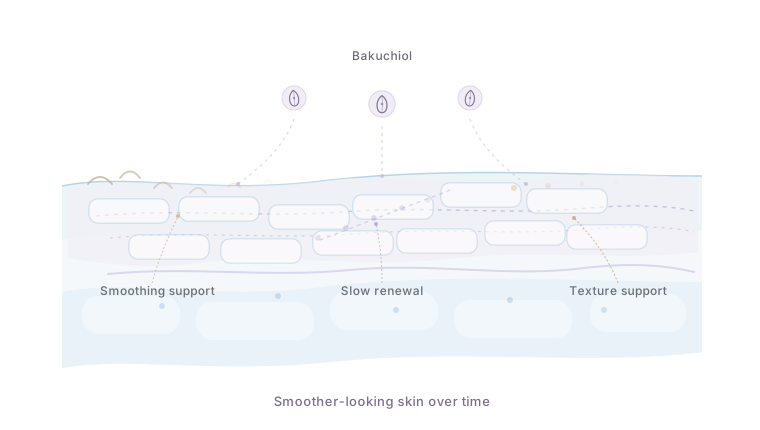
What makes bakuchiol interesting from a reactive-skin perspective is that it appears to produce some of the visible benefits associated with retinoids — smoother-feeling texture, more even skin tone, gentler signs of ageing — without engaging the same mechanism that causes retinoid irritation. It is not chemically similar to vitamin A, which is part of the reason most users tolerate it well: whatever bakuchiol does, it does differently enough that the typical retinoid side effects mostly do not appear.
The published research on bakuchiol is interesting but still developing. A small number of clinical studies have compared it directly to retinol and found comparable effects on smoothness and tone markers with substantially less irritation — promising, but based on limited sample sizes and relatively short study durations. This is an ingredient whose honest story is ‘promising with meaningful early evidence’, not ‘proven equivalent to retinol’.
Bakuchiol as gentle smoothing support
Why bakuchiol matters for sensitive and reactive skin
Bakuchiol exists in a very specific gap: the space between ‘I want some anti-ageing and texture support in my routine’ and ‘I cannot use retinoids’. For users who fall into that gap — which is a significant proportion of reactive-skin users — the alternatives have historically been limited to the kind of vague ‘firming’ and ‘smoothing’ claims that marketing makes without much delivery.
Bakuchiol is especially useful when skin feels:
- reactive but also wanting gentle texture or smoothing support
- drawn to anti-ageing ingredients but unable to tolerate retinol or its derivatives
- in need of a slow-building active rather than an aggressive one
- looking for an evening ingredient that does not require the buffering and recovery of a retinoid routine
Bakuchiol also tends to work well alongside the other foundational ingredients in a sensitive-skin routine. It pairs naturally with niacinamide for broader resilience support, with ceramides and glycerin in a barrier-first base, and with the Vitamin C Defence System on the antioxidant side of a daytime-evening split routine. Unlike retinol, it does not require elaborate pairing rules or avoidance lists.
For routine-building, the practical position is this: if niacinamide is the default foundational active and azelaic acid is the specialist for reactive-blemish concerns, bakuchiol is the specialist for reactive-ageing concerns. It is not a competitor to either — it occupies its own territory.
The retinol comparison, honestly
Because bakuchiol is almost always discussed alongside retinol, it is worth being precise about how the two actually compare — rather than repeating the ‘natural alternative’ marketing line.
Where bakuchiol can reasonably substitute for retinol: for users whose skin is too reactive to use retinol at any meaningful concentration, bakuchiol offers some of the smoothing and tone-evening benefits with considerably less irritation. For readers in this position, bakuchiol is likely the more useful choice — not because it matches retinol on performance, but because a tolerated 1% bakuchiol in the routine will outperform an untolerated 0.3% retinol that sits in the drawer.
Where bakuchiol does not substitute for retinol: for users who can tolerate retinoids well, bakuchiol is likely less effective. The existing evidence suggests comparable results at the margin, but retinol’s clinical track record is considerably deeper, and the most visible, measurable, documented anti-ageing performance still comes from well-tolerated retinoid use.
The ‘natural alternative’ framing in marketing oversimplifies this. Bakuchiol is not a plant version of retinol — it is a different ingredient that happens to produce some overlapping visible effects. For some readers, that distinction is academic. For others, it is the whole point: they are not replacing retinol with a natural version, they are using a different ingredient that fits their skin’s realistic tolerance.
What it cannot do
Bakuchiol is a useful ingredient, but a few caveats are worth naming clearly.
The research base is still developing. Compared to retinol, bakuchiol’s clinical evidence is limited in scope, sample size, and duration. This is not a reason to avoid it — the early evidence is consistent and promising — but it does mean that confident claims about equivalence or superiority to retinol are getting ahead of what the data actually supports.
It is not fast. Like most slow-build actives, bakuchiol’s effects appear over two to three months of consistent use, not weeks. Readers expecting rapid visible change will be underwhelmed.
Concentration and formulation matter more than with many ingredients. Bakuchiol is not particularly water-soluble and can be unstable in poorly built formulas. Products that list bakuchiol prominently but position it at the tail of a long INCI list are often underdelivering. Well-formulated bakuchiol serums tend to use oil-friendly bases and list the ingredient near the top.
And finally, the ‘pregnancy-safe retinol alternative’ framing is worth treating with some caution. While bakuchiol’s mechanism is different from retinoids and the existing evidence does not flag the same concerns, the specific studies on pregnancy safety are limited. If this is the deciding factor in your choice, checking with a healthcare provider rather than relying on marketing language is the honest answer.
Is bakuchiol good for sensitive skin? The Clarity Verdict
Bakuchiol is a Green List specialist and one of the most useful ingredients for reactive users who cannot tolerate retinoids. We value it most in evening serums, moisturisers, and routines aimed at reactive skin looking for some smoothing or anti-ageing support without the retinoid commitment.
For readers who have tried retinol and found it unworkable — or who want to avoid that path altogether — bakuchiol is the most reasonable alternative available in sensitive skincare. It is not retinol, and the honest story is better than the ‘natural retinol’ marketing claim anyway: it is a different ingredient that happens to do useful overlapping work for the specific skin type that retinoids do not suit.
How to use bakuchiol
Best For
- Early ageing concerns
- Texture support
- Dull reactive skin
- Retinoid-cautious users
Use When
- In evening routines
- During calm phases
- As a gentler retinoid alternative
- In slow-introduction routines
Products featuring bakuchiol
Our ingredient-led product recommendations are being prepared and will be added soon.