
Ectoin
A modern comfort ingredient that helps skin hold its resilience against environmental stress — pollution, wind, UV exposure, and urban strain.
Some reactive skin is not flaring because of a specific trigger — it is quietly worn down by everything at once. Long commutes, air conditioning, pollution, UV exposure, dry planes, cold wind. The skin is not damaged, exactly, but it is tired. Traditional calming ingredients address inflammation; hydrators address dryness. Ectoin addresses something else — the cumulative environmental load that shows up as a low-grade feeling of skin being ‘not quite right’.
On this page
The Clarity Summary
Ectoin is one of the more modern ingredients in the Skincare Clarity library. Unlike cica or oats, which have histories measured in centuries, ectoin came into skincare from biotechnology research — originally studied for its role in helping microorganisms survive in extreme environments. In skincare, it behaves as an environmental stress protectant and surface hydrator, particularly suited to reactive skin exposed to urban or climate-driven stressors.
For Skincare Clarity, ectoin has earned its Green List status as the third comfort-focused pillar alongside cica and oats — not because it does what they do, but because it does something different that modern reactive skin increasingly needs.
What is ectoin?
Ectoin is a small molecule classified as an extremolyte — a compound produced naturally by certain microorganisms that live in extreme environments, such as salt lakes, deserts, and geothermal waters. These microbes produce ectoin to help their own cellular structures survive conditions that would normally cause significant stress: high salt, intense UV, drought, temperature extremes.
The ectoin used in skincare is produced through biotechnology rather than harvested from natural environments — typically through fermentation processes using the same microbes, grown under controlled conditions. On INCI lists it appears simply as Ectoin or occasionally as Ectoine. It is one of the few ingredients in the library with this kind of background — modern in origin, scientifically developed, and not part of any traditional skincare tradition.
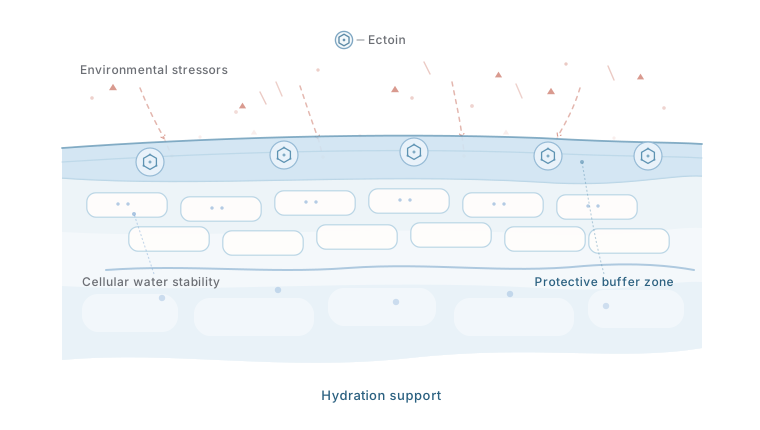
What makes ectoin interesting from a sensitive-skin perspective is its mechanism. It is classified as an osmolyte — a molecule that helps stabilise the water balance and protein structures at a cellular level. In skin, this translates into a kind of internal water stability and stress support that does not behave like a traditional humectant or a traditional soothing ingredient. It sits in its own small category, and that is where its value comes from.
The ingredient has been studied in clinical contexts including sun-exposed skin, atopic skin, and post-procedure recovery, with a research base that is unusually strong for a relatively young skincare ingredient.
Ectoin as a protective buffer zone
Why ectoin matters for sensitive and reactive skin
Modern reactive skin deals with a load that older skincare was not designed for. Urban pollution, air-conditioned indoor air, long-haul flights, and more intense UV exposure all place a kind of low-grade, cumulative stress on the skin barrier that is different from an acute reaction or a dry-skin flare. This is the specific territory ectoin was built for.
Ectoin is especially useful when skin feels:
- worn out by urban life — pollution, commuting, indoor heating and cooling
- drier and more fragile after flying, particularly on long flights
- stressed by sun exposure even when it is not visibly burnt
- subtly compromised after seasonal shifts or travel
- not flaring but not comfortable either — that ‘low-grade off’ feeling
The strongest scenario for ectoin is ongoing environmental strain. For readers whose skin is reactive because of where and how they live — urban environments, air-conditioned offices, high-travel routines, variable climates — ectoin tends to make a noticeable difference in how resilient the skin feels across the day. It is less about fixing a specific problem and more about raising the skin’s baseline tolerance to the stressors it is routinely exposed to.
It also works well as a pre-emptive ingredient. Unlike cica or oats, which are most associated with calming skin that is already reactive, ectoin is often used preventatively — built into formulas used daily before stress exposure, rather than applied in response to it. This makes it particularly valuable in SPFs, daytime moisturisers, and serums designed for protection rather than recovery.
That does not make ectoin a sunscreen ingredient. It can support environmental-stress routines, including daytime formulas worn alongside SPF, but it is not a UV filter and does not replace sunscreen.
Ectoin pairs naturally with panthenol for comfort, with ceramides for barrier support, and with niacinamide for day-to-day resilience. It sits comfortably alongside most other Green List ingredients without interference.
How ectoin differs from cica and oats
Since all three anchor the Soothing Superstars category, being precise about the differences matters.
Cica is the sharpest tool for acute calming — visible redness, active flare-ups, post-procedure recovery. It has the strongest research base for helping already-reactive skin settle.
Oats are the best choice for sustained everyday comfort — chronically reactive skin, itch-prone skin, daily tolerance work. Their contribution is slow and cumulative.
Ectoin sits in a different place again — the environmental resilience space. It is less about calming what has already flared and more about helping the skin cope with the cumulative daily load that modern life places on it.
A well-built reactive-skin routine can include all three. They are not competing ingredients; they are addressing different aspects of the same general challenge. A morning SPF with ectoin, a comfort moisturiser with oats, and a cica-based recovery serum for flare weeks is a reasonable distribution of the three roles.
What ectoin cannot do
Ectoin is a strong ingredient, but its territory is specific.
It is not a calming ingredient for active inflammation. Despite appearing in the Soothing Superstars category, ectoin is not the ingredient to reach for when skin is visibly red, stinging, or inflamed in the moment. Its work is protective and supportive rather than directly calming. For acute flares, cica and panthenol remain the stronger tools.
It is not a replacement for hydration ingredients. Ectoin contributes a kind of internal water stability, but it does not attract water to the skin the way glycerin or hyaluronic acid do. A formula relying on ectoin as its primary hydrator will usually feel thin. The best ectoin products pair it with traditional humectants rather than using it alone.
The research base is strong but still relatively young. Compared to oats or ceramides, ectoin has a shorter history in clinical dermatology — promising, well-studied, but still an ingredient whose long-term role in skincare is being defined. This is not a reason to avoid it, but it is worth knowing that the evidence base will continue to develop over the coming years.
And finally, ectoin is a quieter ingredient than its marketing sometimes suggests. It does not produce dramatic immediate results. What it does is subtle, cumulative, and most noticeable in comparison — a routine with ectoin tends to feel more resilient over weeks of use, rather than transformative overnight. Users expecting a quick-fix experience may feel underwhelmed; users paying attention to long-term skin behaviour tend to find it quietly valuable.
Is ectoin good for sensitive skin? The Clarity Verdict
Ectoin is a foundational Green List ingredient and one of the most forward-looking comfort ingredients in the library. We value it most in SPFs, daytime serums, and moisturisers aimed at readers whose reactive skin is shaped by modern urban life, environmental exposure, or travel.
If you live somewhere with real environmental pressure on your skin — a polluted city, a very dry climate, or a lifestyle that involves regular long-distance travel — ectoin is one of the more meaningful modern additions you can make to a daily routine. It will not replace your calming, hydrating, or barrier-supporting ingredients, but it addresses a layer of the reactive-skin story that they do not quite cover.
How to use ectoin
Best For
- Weather-stressed skin
- Reactive urban skin
- Tight, unsettled skin
- Barrier support routines
Use When
- Morning and night
- During environmental stress
- In travel routines
- In reactive phases
Products featuring ectoin
Our ingredient-led product recommendations are being prepared and will be added soon.