
Niacinamide
A well-tolerated form of vitamin B3 that supports barrier resilience, tone, and general skin comfort for reactive users.
For reactive skin, ‘active’ is usually a word that triggers hesitation. Most actives come with a caveat — build up slowly, patch test first, expect some redness, avoid combining with. Niacinamide is the one that mostly does not. It does meaningful work on barrier, tone, and oil regulation, and it does it without the friction that defines most of the active category. Which is why it has quietly become the default starting active for sensitive skin — and why understanding what it does and does not do is worth getting right.
On this page
The Clarity Summary
Niacinamide is a form of vitamin B3 that has become one of the most widely used actives in modern skincare. Unlike most actives, it is remarkably well tolerated — even by reactive, sensitive, or barrier-compromised skin — which makes it one of the few performance ingredients that fits into the Green List philosophy rather than sitting on the edge of it.
For Skincare Clarity, niacinamide is the foundational Gentle Active. It does several jobs at once, mostly to a modest standard, with an unusually clean tolerance profile. That combination is rare, and it is what makes niacinamide the most reasonable first active for sensitive skin users.
What is niacinamide?
Niacinamide — also known as nicotinamide — is the topically active form of vitamin B3. On INCI lists it appears under either name, most commonly ‘Niacinamide’. It is a small, stable, water-soluble molecule that absorbs well into the upper layers of the skin, where it participates in a range of cellular processes relevant to skincare.
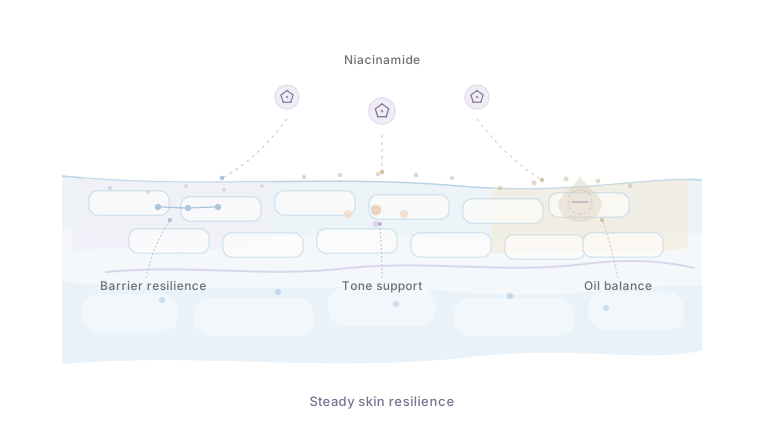
What makes niacinamide distinctive is its breadth of action. Most skincare actives have one primary mechanism — an AHA exfoliates, a retinoid accelerates cell turnover, a vitamin C antioxidant protects against environmental stress. Niacinamide does several things at a gentler level: it supports the skin’s own production of barrier lipids like ceramides, contributes to a more even skin tone over time, helps regulate sebum in oil-prone skin, and offers mild antioxidant support.
This breadth is a strength and a limitation at the same time. Niacinamide rarely does any single thing as dramatically as a more specialised active would. But the combined effect — better barrier resilience, gentler tone improvement, reduced oiliness, more even skin behaviour day to day — is often more useful for reactive skin than a single aggressive active would be. Most sensitive-skin users do not need a single heroic ingredient. They need a well-tolerated all-rounder that fits into a barrier-first routine without friction.
The typical effective concentration is 2–5%. Above 5%, some users report mild flushing or discomfort, particularly when niacinamide is paired with other actives. For most reactive skin, a formula at 4% or below is a better starting point than a more concentrated one.
Niacinamide as steady skin resilience support
Why niacinamide matters for sensitive and reactive skin
Niacinamide fits reactive skin in a way most actives do not. It is one of the few performance ingredients that can be used twice a day, layered freely with other Green List ingredients, and introduced to a sensitive routine without a careful build-up period. For readers who have historically struggled to tolerate actives, niacinamide is often the one that finally works.
Niacinamide is especially useful when skin feels:
- reactive and blemish-prone at the same time
- uneven in tone, with lingering marks after blemishes or flares
- oil-prone in some areas while dehydrated elsewhere
- generally unsettled after trying stronger actives without success
- in need of gentle long-term improvement rather than dramatic intervention
Niacinamide’s strongest honest case is as the active that works for skin that does not tolerate others. Where azelaic acid or retinoids can be too much for reactive users, niacinamide usually is not. Where stronger tone-correcting ingredients cause irritation that outweighs the benefit, niacinamide contributes its modest tone support without that cost. And where a barrier-compromised routine cannot accommodate a traditional active, niacinamide often slots in without disturbing the balance.
It also has a useful role as a pairing ingredient. Niacinamide combines well with hyaluronic acid, ceramides, panthenol, and bakuchiol — essentially the backbone of a sensitive-skin routine. It does not conflict with retinoids or vitamin C despite older internet advice suggesting otherwise, and modern formulation has largely settled that question.
What it cannot do
Niacinamide is versatile, but it is not a cure-all, and some of its marketing does overclaim.
It is not a replacement for a retinoid. For users targeting deeper lines, pronounced texture issues, or significant photoageing concerns, niacinamide is a useful supporting ingredient but not a substitute for retinoids or bakuchiol. Marketing that positions niacinamide as a ‘gentle alternative’ to retinoids oversells the comparison — they do different things.
It is not fast. Niacinamide’s effects build over weeks and months, not days. If you are looking for a visible change within a week or two, niacinamide is the wrong expectation. For steady, cumulative improvement over a longer period, it is one of the most reliable choices — but you need to use it consistently for that to show.
Concentration above 5% is not automatically better. Some products market ‘10% niacinamide’ as a premium positioning, but higher concentrations do not translate into proportionally better results, and they can increase the risk of flushing or mild irritation — even in otherwise tolerant skin. For sensitive users, 4% niacinamide in a well-built formula will usually outperform 10% in a thin one.
And finally, niacinamide does not do much for active inflammation. It is a resilience-building ingredient rather than a calming one. For visible redness, flaring, or post-procedure recovery, cica, panthenol, or ectoin do more direct work. Niacinamide can sit alongside them, but it is not the right ingredient to reach for in an acute reactive moment.
Is niacinamide good for sensitive skin? The Clarity Verdict
Niacinamide is a foundational Green List active and the most reasonable starting point for any sensitive-skin user building an actives routine. We value it most in serums, moisturisers, and SPFs aimed at reactive skin that wants some performance without the risk of irritation.
If you have historically avoided actives because your skin does not tolerate them well, niacinamide is the single ingredient most worth trying first. It will not transform your skin dramatically, but for what it does — steady barrier, tone, and oil-regulation support in an unusually well-tolerated form — it is probably the most useful active in modern sensitive skincare.
How to use niacinamide
Best For
- Reactive combination skin
- Post-blemish marks
- Uneven tone
- Barrier support
Use When
- Morning or night
- In simplified routines
- During mild reactive phases
- Under moisturiser or SPF
Products featuring niacinamide
Our ingredient-led product recommendations are being prepared and will be added soon.