
Methylisothiazolinone (MI)
A potent preservative with a well-documented sensitisation profile — already restricted in UK and EU cosmetic regulation, and excluded entirely from the Skincare Clarity curation.
Some Red List entries require an editorial argument; this one does not. Methylisothiazolinone is one of the more clear-cut exclusions in the Skincare Clarity library because the case against using it freely was made by regulators and dermatologists more than a decade ago. The American Contact Dermatitis Society named it Allergen of the Year in 2013. The EU banned it from leave-on cosmetics from February 2017 and reduced the permitted rinse-off concentration to 15 parts per million, with full compliance required by April 2018. The UK retained those restrictions post-Brexit. For reactive skin, Skincare Clarity goes one step further and excludes it entirely.
On this page
The Red List Verdict
Methylisothiazolinone (MI) and the closely related Methylchloroisothiazolinone (MCI) are powerful antimicrobial preservatives. They work, and at low concentrations they keep cosmetic products safe from microbial contamination — which is genuinely important. The problem is that they are also among the most potent contact sensitisers identified in modern dermatology, and a sharp rise in MI-related allergic contact dermatitis between roughly 2010 and 2015 prompted regulatory restriction across the EU and UK.
Current UK and EU rules ban MI from leave-on products entirely and limit its concentration in rinse-off products to 15 ppm (0.0015%). The Skincare Clarity exclusion is stricter: we do not curate any products that contain MI, MCI, or related isothiazolinones, regardless of concentration or product format. For users already sensitised to MI — often through exposure to higher-concentration formulas in the years before restriction — even products complying with the rinse-off limit may be enough to provoke or maintain a reaction.
What is Methylisothiazolinone?
Methylisothiazolinone (MI) is a preservative used in cosmetic and personal-care products to prevent microbial growth — bacterial, fungal, and yeast contamination that would otherwise spoil a product and create a safety risk for the consumer. It is exceptionally effective at low concentrations, which is one of the reasons it was adopted widely across the industry through the 2000s.
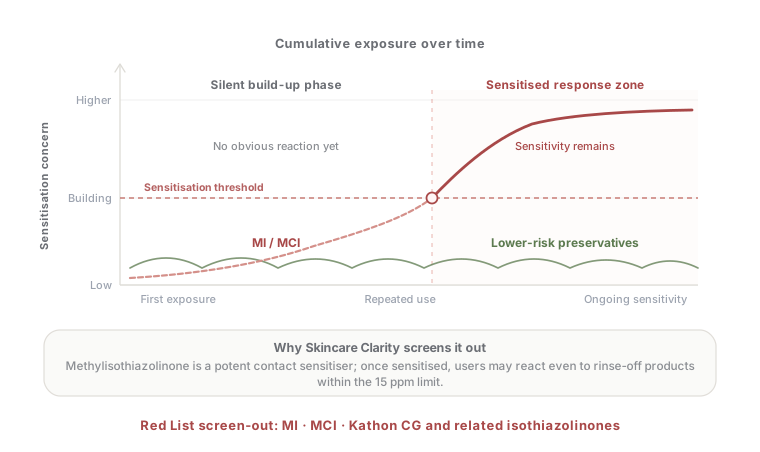
MI is most often paired with Methylchloroisothiazolinone (MCI) in a 3:1 ratio, sold under the trade name Kathon CG. Both belong to the isothiazolinone class, a family of small, highly reactive molecules whose preservative action comes from their ability to bind to and disrupt proteins in microbial cells. That same reactivity is what makes them sensitising: they bind readily to skin proteins as well, where they can trigger Type IV (delayed) hypersensitivity in susceptible users.
Two related isothiazolinones to know about: Benzisothiazolinone (BIT) and Octylisothiazolinone (OIT) are not permitted as cosmetic preservatives in UK or EU cosmetic products, but they are used in non-cosmetic exposure routes such as cleaning products, paints, adhesives and some consumer goods. A subset of MI-sensitised users may also react to related isothiazolinones, so these exposures can matter outside skincare.
The MI epidemic and what regulators concluded
Between approximately 2010 and 2015, dermatology clinics across Europe and North America reported a sharp rise in cases of allergic contact dermatitis attributable to MI. Multi-centre studies in Belgium, the UK, the Netherlands, Spain, and Germany all documented a striking increase in patch-test positivity rates over a short timeframe — fast enough that the British Society for Cutaneous Allergy and the American Contact Dermatitis Society both issued warnings, and the latter named MI Allergen of the Year for 2013.
The European regulatory response was staged. Industry initially recommended voluntary removal from leave-on products in 2013. The EU Scientific Committee on Consumer Safety issued opinions across 2013–2015, with its December 2015 opinion specifically concluding that 100 ppm in rinse-off products could no longer be considered safe from the point of view of induction of contact allergy, while 15 ppm could be considered safe on that basis. EU Regulation 2016/1198 banned MI from leave-on cosmetics, with full compliance required by February 2017. EU Regulation 2017/1224 reduced the rinse-off limit from 100 ppm to 15 ppm, with full compliance required by April 2018. The UK retained these restrictions when EU cosmetic regulation was incorporated into UK law post-Brexit, and they remain in force today.
At 15 ppm, MI is often not relied on as the sole preservative in modern formulas; it may appear as part of a wider preservative system or through preserved raw materials. Regulatory bodies consider this concentration safe for the non-sensitised consumer in rinse-off contexts. For users who have already developed an MI sensitivity — a meaningful population, given the 2010–2015 epidemic — even compliant residual concentrations may be sufficient to provoke or maintain a reaction.
Methylisothiazolinone and sensitisation build-up
Why MI is on our Red List
Skincare Clarity excludes MI and the related isothiazolinones entirely, including from rinse-off products where regulation permits trace concentrations. The reasoning is direct.
For users who have already been sensitised to MI, even 15 ppm in a rinse-off product can be enough to maintain or aggravate a reaction. A reactive-skin curation that retained MI-containing rinse-offs would be unusable for this group, which is precisely the audience the curation is built for. The regulatory threshold is set for the general consumer; it is not the threshold appropriate for already-sensitised reactive users.
For users who are not yet sensitised, the exclusion is precautionary and consistent with the broader Red List logic. MI is not a borderline case where the evidence is unclear or contested — it is one of the most studied contact sensitisers in modern dermatology, and the regulatory restriction reflects a consensus position. Once gentler preservation systems are available and widely used in modern formulation, there is no compelling reason for a reactive-skin curation to retain a known potent sensitiser even at trace levels.
What to look for on a label
On a UK INCI list, MI and the MCI/MI mixture appear under several names:
- Methylisothiazolinone (MI or MIT)
- Methylchloroisothiazolinone (MCI or CMIT)
- The combination is often listed as Methylchloroisothiazolinone (and) Methylisothiazolinone or under the trade name Kathon CG
Where to expect them in a UK or EU product: most often in rinse-off categories — shampoos, body washes, foaming face cleansers, intimate washes — where they are still permitted at 15 ppm. They should not appear in leave-on products from UK or EU brands marketed in this region. They may still appear in leave-on products imported from regions without equivalent restrictions; checking the INCI on imports is worth doing.
In practice, on a compliant UK or EU product, MI must still appear in the ingredient list as Methylisothiazolinone, or in the MCI/MI mixture under both names. For reactive-skin users, those INCI entries on a rinse-off label are reasonable to treat as a stop sign.
What to use instead
The alternative to MI is not a different active ingredient but a different preservation system. Modern reactive-skin formulas are typically preserved with one of three approaches: phenoxyethanol at low concentration (often 0.5–1%), often paired with ethylhexylglycerin; organic acid systems built around sodium benzoate, potassium sorbate, and benzoic acid, usually requiring a slightly acidic formula pH; or multi-functional ingredients like pentylene glycol, propanediol, or 1,2-hexanediol that contribute preservative activity alongside their primary humectant or solvent role. None of these are individually on the Skincare Clarity Green List, but they are the preservation chemistries most commonly seen in well-tolerated formulas.
The product categories where MI appears most often in the UK market — rinse-off cleansers and body washes — are also the categories with the most direct Green List alternatives. Cleansers built around cocamidopropyl betaine and decyl glucoside tend to use the gentler preservation systems described above rather than isothiazolinones, and tend to pair them with comfort ingredients like glycerin, panthenol, or Oat Family extracts. The combination of a gentler surfactant base, a non-isothiazolinone preservation system, and supporting calming actives is the structural pattern worth scanning for when reading a cleanser label.