
Glycolic acid above 5% / salicylic acid above 2%
Two effective exfoliating acids that the curation excludes only above defined concentration thresholds — the only entries on the Red List where the ingredient itself is not the issue.
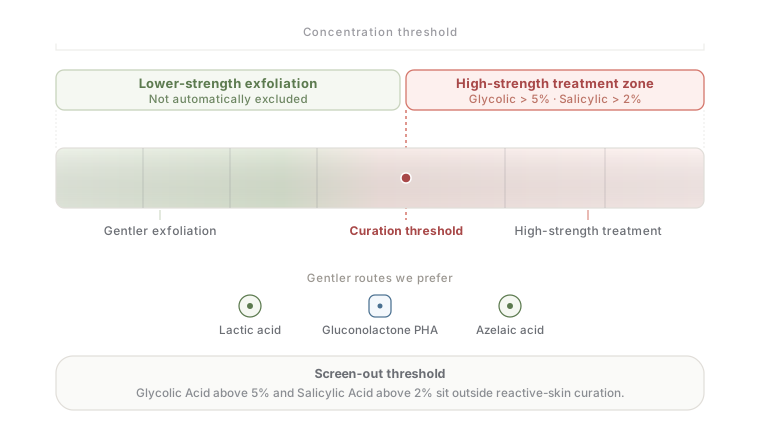
This page is structurally different from every other entry on the Skincare Clarity Red List. Glycolic acid and salicylic acid are not categorically excluded — both are useful, well-studied actives, and at modest concentrations they appear in many formulas a reactive-skin user can reasonably tolerate. What is excluded is high-concentration leave-on use: glycolic acid above 5%, and salicylic acid above 2%. The two thresholds are editorially different: the 2% salicylic ceiling is the existing UK and EU regulatory limit for leave-on cosmetics; the 5% glycolic threshold is a curation-set line above which formulas tend to be too aggressive for the audience the curation serves. We want to be clear about that distinction.
On this page
The Red List Verdict
Both glycolic acid (an alpha-hydroxy acid, AHA) and salicylic acid (a beta-hydroxy acid, BHA) are exfoliants. They work by loosening the bonds between cells in the upper layer of the skin, accelerating the rate at which the skin sheds and renews. Used carefully, they can support smoother texture, more even tone, and clearer pores. Used aggressively — particularly in the unstable, sensitised barrier conditions that define the curation’s audience — they can drive exactly the kind of irritation, redness, and barrier disruption that the curation is built to help users avoid.
The Skincare Clarity exclusion sits at two thresholds. Glycolic acid above 5% is excluded as an editorial threshold: above this, glycolic-led formulas tend to move from supportive daily use into more aggressive treatment territory, with rising rates of stinging, redness, and post-acid sensitivity in reactive skin. Salicylic acid above 2% is excluded because 2% is the current UK and EU regulatory ceiling for leave-on cosmetic products in the relevant exfoliating categories; the curation observes that ceiling strictly and watches for emerging restrictions, including a 2025 SCCS opinion that has flagged 2% as unsafe for several product categories in children aged 3–10 when aggregate exposure is considered.
High-percentage acids as a concentration threshold
What are glycolic acid and salicylic acid?
Glycolic acid is an alpha-hydroxy acid (AHA) — the smallest molecule in the AHA family, derived historically from sugar cane and now produced synthetically. Its small size is the source of both its effectiveness and its capacity to irritate: it penetrates the upper skin layers more readily than larger AHAs like lactic acid or mandelic acid, which means it can deliver visible exfoliation at lower concentrations, but also that it crosses into the barrier with less buffering when applied at higher concentrations. Glycolic acid is water-soluble and works primarily on the skin’s surface.
Salicylic acid is a beta-hydroxy acid (BHA), structurally related to acetylsalicylic acid (aspirin) and historically derived from willow bark, now produced synthetically. Unlike AHAs, it is oil-soluble — which means it can dissolve into pore lining and provide exfoliation inside the follicle. It also has a mild anti-inflammatory effect, which is one of the reasons it is the standard active in many over-the-counter acne products. Salicylic acid is the most widely used BHA in cosmetic formulation.
The performance of either acid on skin depends not only on concentration but also on the formula’s pH and the proportion of acid present in its active free-acid form. A 5% glycolic at pH 3.0 is more aggressive than the same 5% at pH 4.0; pH is generally not declared on an INCI list, which is one of the reasons concentration alone is an imperfect signal but still the most practically useful one available to a label-reader.
Glycolic acid above 5% — why we draw the line here
Glycolic acid is permitted in UK and EU cosmetic products without a specific concentration cap comparable to the salicylic acid limit. Cosmetic formulations span a wide range — from 2% in light ‘daily exfoliant’ toners up to 10% or higher in stronger leave-on treatments, with professional-strength peels going considerably higher. The range itself is not the problem; the problem is matching concentration to skin tolerance, and reactive skin tends to tolerate considerably less than non-reactive skin.
The 5% threshold is a curation-set line, and we want to be honest about that. There is no regulatory authority in the UK or EU that defines 5% as the safe ceiling for cosmetic glycolic acid. The threshold reflects three judgements about the curation’s audience:
First, formulas at or below 5% — particularly when buffered to pH 4 or higher — tend to deliver supportive surface exfoliation without crossing into the territory where stinging, redness, and post-acid sensitivity become common. Second, formulas above 5% — particularly in the 8–10% range typical of stronger treatment products — move closer to intensive exfoliation territory, where reactive skin is more likely to struggle, and the cumulative effect on reactive skin with frequent or repeated use is often where barrier issues start. Third, where higher-concentration glycolic exfoliation is genuinely needed for a specific concern, that is the territory of in-clinic peels under professional supervision rather than at-home daily use, and the curation defers to that distinction.
The threshold is not a claim that 6% glycolic is harmful and 5% is safe. It is the line above which the curation no longer recommends a product as appropriate for daily reactive-skin use without a more specific clinical justification.
Salicylic acid above 2% — why we draw the line here
Salicylic acid is already restricted under UK and EU cosmetic regulation, with concentration limits that vary by product category. For the type of leave-on exfoliating products most relevant to this curation, 2% is the practical ceiling; some product categories are subject to lower limits. Skincare Clarity therefore treats anything above 2% in a consumer leave-on exfoliant as outside the curation.
Two points are worth noting alongside the regulatory baseline. First, products marketed as cosmetic in the UK or EU should not exceed the applicable category limit for salicylic acid in leave-on use. Higher-concentration salicylic acid products may exist in other markets or professional/medicinal contexts, but they sit outside compliant UK/EU cosmetic leave-on use at the relevant category limit. A consumer cosmetic product claiming to contain salicylic acid above the relevant category limit in a leave-on format is either non-compliant with UK/EU regulation, an import from a market with different rules, or sold under a different category that the cosmetic regulation does not cover.
Second, the regulatory picture is moving. In April 2025, the EU Scientific Committee on Consumer Safety adopted its final opinion on salicylic acid in children’s exposure (SCCS/1675/25). The opinion concluded that, when aggregate exposure is considered, salicylic acid at 2% is not safe for selected dermally applied products used by children aged 3–10, including face moisturiser, hand cream, liquid soap, and shower gel. Salicylic acid is already prohibited for use in cosmetic products for children under 3. That opinion may inform future restrictions for the 3–10 age group if implemented in regulation.
For an adult reactive-skin curation, 2% salicylic acid in a well-formulated leave-on product within an appropriate category is not categorically excluded — the threshold simply reflects the regulatory ceiling for that category. Concentrations above the relevant category limit should not appear in compliant UK or EU cosmetic products in leave-on use, and where they do appear, the product is outside the curation.
The reactive-skin angle
Both acids share a practical pattern in reactive skin that is worth stating directly. The skin types this curation is built for — rosacea-prone, eczema-prone, post-procedure, or skin currently in a flare — are the skin types most likely to tip from ‘tolerating an acid well’ into ‘reacting to an acid that previously seemed fine’. The threshold for this tipping point is lower than for non-reactive skin, the recovery is slower, and the cumulative effect of repeated low-grade reactions is barrier fragility that compounds over weeks rather than resolving in days.
This is not an argument against exfoliating acids in reactive skin. It is an argument for using gentler chemistry, lower concentrations, less frequent application, and well-formulated supporting bases — and for being especially careful with the higher-concentration end of both acid families. The curation’s preference is for the gentler end of the AHA and BHA spectrum, plus alternatives in adjacent ingredient families that achieve similar goals through different mechanisms.
What to look for on a label
On a UK INCI list, the two acids appear under their direct names:
- Glycolic Acid (and related: Ammonium Glycolate, Sodium Glycolate as buffered forms)
- Salicylic Acid, plus related salts such as Sodium Salicylate or Potassium Salicylate, which may appear in supporting or preservative-related roles rather than as direct exfoliating acids
Where to expect them in concentrations above the curation’s thresholds:
- ‘Treatment’ toners, ‘resurfacing’ pads, and ‘renewal’ serums often sit at 7–10% glycolic acid — outside the curation
- Some ‘exfoliating’ or ‘spot treatment’ products marketed for acne may approach the 2% salicylic ceiling; products claiming concentrations above 2% in leave-on UK or EU sales are non-compliant
- ‘Strong’ or ‘professional’ peel products containing high-concentration salicylic acid are outside compliant UK/EU cosmetic leave-on use; high-concentration glycolic peel-style products are outside the Skincare Clarity curation even where the regulatory status differs
INCI position is a useful but imperfect concentration signal: an acid listed near the top of an ingredient list usually indicates a higher concentration, while an acid listed lower indicates it is one supporting active among several. Brands that disclose specific acid percentages on the label — common in active-skincare-focused brands — make this judgement easier.
A practical signal: a formula that combines a low-concentration acid (glycolic at 4–5%, salicylic at 1–2%) with supporting calming and barrier ingredients tends to be the kind of acid use the curation considers appropriate. A formula that places an acid at high concentration with minimal supporting context, often marketed on the strength of the acid alone, tends to be the kind the curation excludes.
What to use instead
For reactive skin, the goal is exfoliation that supports surface renewal without triggering the cycle of stinging, sensitivity, and barrier disruption that aggressive acids tend to drive.
Within the AHA/BHA family, lactic acid is the closest direct alternative to glycolic acid: it is a larger molecule, penetrates the skin more slowly, and is generally better tolerated in reactive skin at comparable percentages. Gluconolactone (PHA) sits among the gentlest tiers of the hydroxy acid family — a polyhydroxy acid with a still-larger molecular structure, providing chemical exfoliation with a low reported irritation profile in the category. For reactive skin specifically, these two are the curation’s preferred AHA/BHA alternatives.
For the goals that high-concentration glycolic or salicylic acid is often used to address — pigmentation, congestion, uneven texture — the curation also points to ingredients that achieve similar outcomes through different mechanisms. Azelaic acid addresses pigmentation, redness, and acne-prone congestion through anti-inflammatory and tyrosinase-inhibition pathways rather than chemical exfoliation. Niacinamide supports pigmentation, barrier function, and sebum regulation through a different set of mechanisms again, and is generally well-tolerated alongside or instead of acid-based routines.
Whichever direction a reactive-skin user chooses, the supporting cast matters. Calming and barrier ingredients like Oat Family extracts, bisabolol, allantoin, panthenol, and glycerin are the structural pattern that distinguishes a well-formulated acid product from a high-concentration acid in a thin vehicle.