
Build your routine
Skincare order: what goes first, and where SPF goes
The order for morning and evening, from cleanser to sunscreen, and where serums, oils and prescribed treatments fit.
On this page
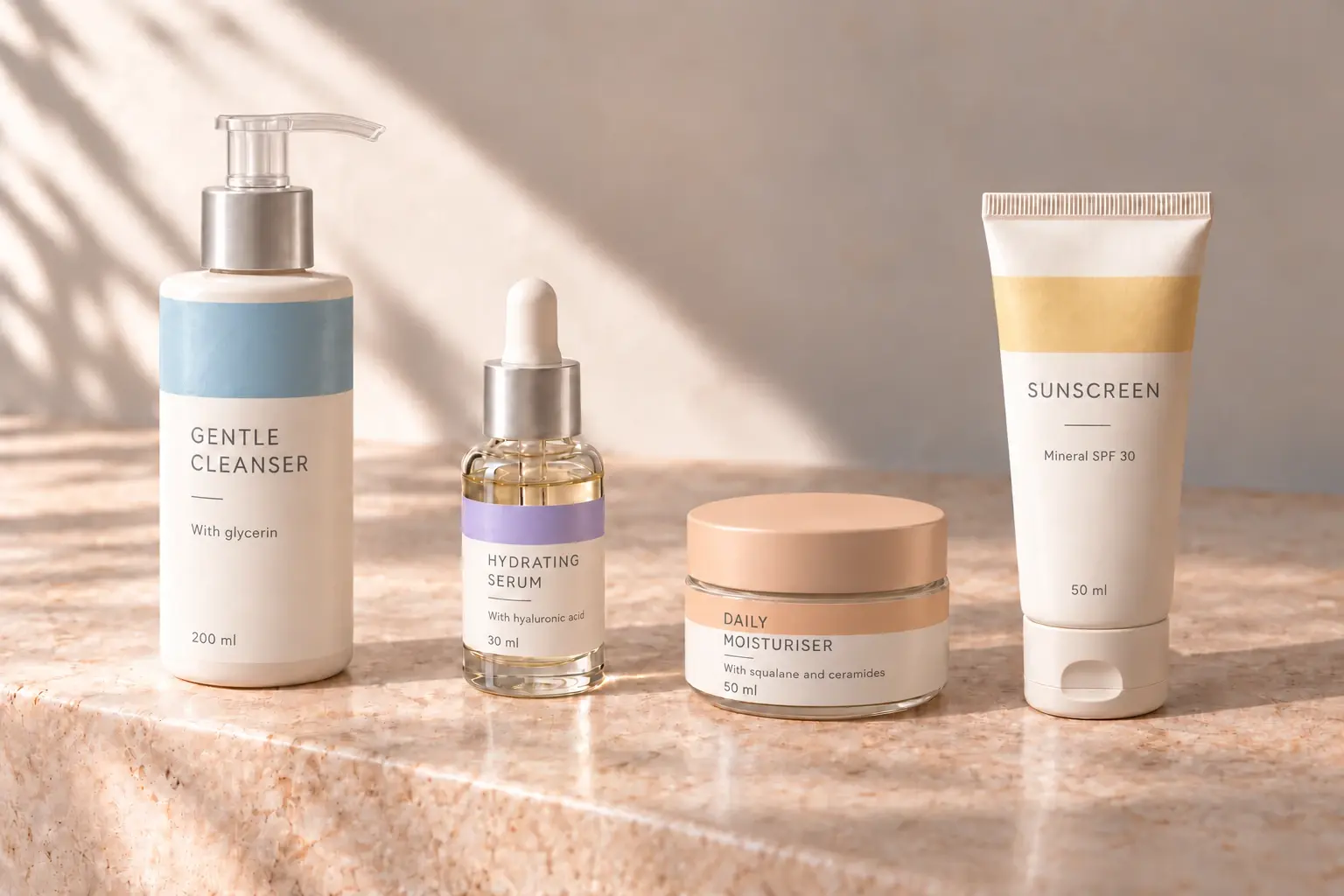
The short answer: cleanse first, then any serum or treatment, then moisturiser, and in the morning finish with sunscreen. That’s a general starting sequence, and most other products fit into it. The rest of this guide explains the reasoning, the exceptions and where oils, balms and prescribed treatments go.
Clarity Summary
- Thin before thick. Watery products first, richer ones later.
- Sunscreen last. It goes over moisturiser, before make-up, in a generous layer.
- Directions win. A product’s own instructions, or your prescriber’s, override any general rule.
- Fewer steps, fewer problems. Many sensitive-skin routines need only cleanser, moisturiser and sunscreen.
The order at a glance
Morning
- Cleanse, or rinse with water
- Serum (optional)
- Moisturiser
- Sunscreen
Evening
- Cleanse
- Treatment or serum (optional)
- Moisturiser
- Balm or facial oil (optional)
Cleanser, moisturiser and morning sunscreen are the core. The optional steps are there if your skin needs them, not because a routine is incomplete without them.
Why this order works
The American Academy of Dermatology gives a simple sequence: wash your face, apply any treatment straight after cleansing, then moisturiser and sunscreen, then make-up if you wear it (AAD, skin care order).
Within that, going from the thinnest, most watery product to the richest is a practical default. A water-based serum spreads easily on clean skin, and a cream or balm then sits over it and helps slow water loss. A rich cream first and a watery serum on top tends to work against both. When a product’s directions say something different, follow the directions.
Sunscreen before or after moisturiser?
After. Apply sunscreen over moisturiser and before any make-up, so it forms an even layer that isn’t diluted or covered by other skincare.
A few things matter more than the order itself:
- Use enough. The AAD suggests at least a teaspoon for the face (AAD, how to apply sunscreen). It is easy to use less than that without noticing.
- Give it time. The AAD advises applying sunscreen before you go outside, as it takes about 15 minutes to absorb, and reapplying every two hours outdoors, or straight after swimming or sweating.
- Let moisturiser settle first. Sunscreen tends to go on more evenly once the layer underneath has settled.
If you use a moisturiser with SPF instead of a separate sunscreen, it becomes your last skincare step. The British Association of Dermatologists notes that SPF moisturisers can fall short when they’re applied thinly or have limited UVA protection. It recommends a sunscreen of at least SPF 30 with UVA protection (BAD, sunscreen fact sheet). A separate sunscreen can make it easier to apply enough. The same order applies whether you use a mineral sunscreen or any other type; our screened SPF selection favours mineral filters.
Serum before or after moisturiser?
Before, in most routines. Many serums are light, water-based formulas built around humectants such as hyaluronic acid or glycerin, or a targeted ingredient such as niacinamide. Humectants help skin hold water; a moisturiser adds emollients or occlusives that slow water loss (Purnamawati et al., 2017).
So a hydrating serum usually goes on before your moisturiser. Follow its directions on whether skin should be damp or dry; active serums may have different instructions.
Where facial oils and balms go
Oils and balms are usually the last step at night, over your moisturiser. Applied there, they add an extra layer that softens the skin and slows water loss. A single-ingredient oil such as squalane can also be mixed into your moisturiser if you prefer one step.
In the morning, keep any oil before your sunscreen, never on top of it, so the sunscreen stays the outermost layer. On dry patches, a balm can go just on the areas that need it rather than all over. The recovery balms and oils collection shows the formats we’ve screened.
Where other steps fit
- Toners and essences usually go straight after cleansing, before serums.
- Eye creams usually go before moisturiser, or in place of it around the eyes.
- Spot treatments follow their own directions. Many are applied to clean skin before moisturiser.
- Make-up goes on after sunscreen has settled.
Prescribed treatments follow their own instructions
If a treatment has been prescribed for you, its order and timing come from your prescriber or the patient information leaflet, not from a general skincare rule. Some prescribed treatments need to go on clean, dry skin, some need a gap before other products, and some shouldn’t be used alongside certain ingredients.
Don’t change how you use a prescribed treatment without checking with your prescriber or pharmacist. If you’re unsure where your other products fit around it, ask.
Do you need to wait between layers?
Most everyday products don’t come with a set waiting time. Let each layer settle enough that the next one spreads evenly.
The exceptions are products with their own instructions: sunscreen needs time before you go outside, and some treatments specify a gap. If products ball up or ‘pill’ when you layer them, try using less of each, letting each layer settle a little longer, or dropping a step.
Fewer steps make the order easier
The more products you layer, the more ways they can clash, pill or irritate, and the harder it is to tell which one is responsible when something goes wrong. Many people with sensitive skin do best on a short routine: a gentle cleanser, a moisturiser that covers the roles their skin needs, and sunscreen in the morning.
If you want to add something, add one product at a time, so you can tell what’s helping and what isn’t. Our guide to choosing a moisturiser shows how to check what your moisturiser already covers, and if your skin is already reacting, our guide to a damaged skin barrier explains why simplifying comes first.
Sources
- American Academy of Dermatology. Should I apply my skin care products in a certain order?
- American Academy of Dermatology. How to apply sunscreen. Updated 15 August 2025.
- British Association of Dermatologists. Sun Protection Fact Sheet, including the section on SPF in moisturisers.
- Purnamawati S, Indrastuti N, Danarti R, Saefudin T (2017). The role of moisturizers in addressing various kinds of dermatitis: a review. Clinical Medicine & Research, 15(3–4), 75–87. DOI: 10.3121/cmr.2017.1363.
Thin-to-thick layering and the placement of toners, eye creams and oils are practical conventions rather than findings from a specific study.