
Choose with confidence
How to choose a moisturiser for sensitive skin
Compare formats, read ingredient roles and find a sensible starting point for sensitive skin.
On this page
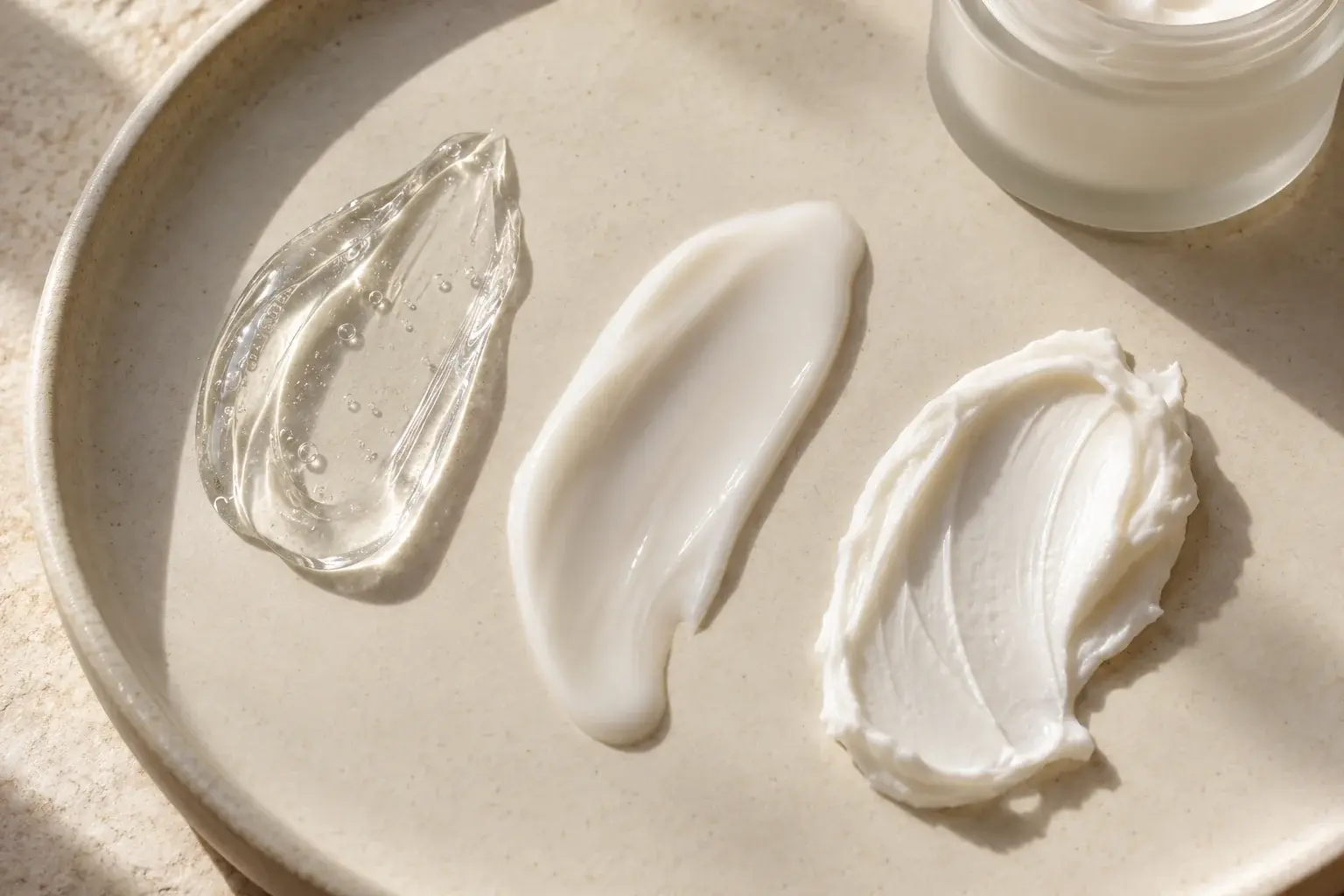
Choosing a moisturiser for sensitive skin means comparing the whole formula, alongside how it fits your routine and budget. This guide uses screened UK examples to show what to look for.
Clarity Summary
- Know what you need. Start with what your skin needs now, your known triggers and a format you’ll actually use.
- Read the full list. Look for ingredients that bind water plus ones that soften skin or slow water loss; ceramides are a useful extra, not a requirement.
- Look past the claims. ‘Sensitive’, ‘hypoallergenic’ and ‘natural’ don’t replace checking the ingredients.
- One product at a time. Keep the rest of your routine familiar so it’s easier to work out what changed.
Start with what your skin needs now
‘Sensitivity’ doesn’t tell you how rich your moisturiser should be. You might have dry, flaky cheeks, an oily forehead, or skin that changes with the weather. Those are different starting points, even when all three come with a history of reactions.
Before shopping, describe the problem you’re trying to solve:
- Dryness or flaking: consider a cream, including ingredients that help reduce water loss.
- A preference for a lighter format: start by comparing gels, gel-creams and fluids.
- Different needs across your face: you can use more on drier areas rather than making one amount suit everywhere.
- A product you already tolerate: keep it in the comparison. Another formula having more highlighted ingredients isn’t a reason to replace something that works for you.
These are starting points for choosing, not a diagnosis. Sensitive skin and a damaged barrier aren’t interchangeable; sensitivity can have several causes. Our damaged skin barrier guide explains the barrier side in more detail.
Think about use as well. Do you want one cream for face and body, a fluid for daytime, or a richer cream for evenings? A useful shortlist should fit your routine and budget, not just your ingredient wish list.
Read the formula before trusting the front label
Start with your own history. If an ingredient has been identified as an allergen for you, that matters even when it appears on our Green List. If a previous moisturiser caused a reaction, keep its ingredient list, but don’t assume the most recognisable ingredient was responsible.
Next, read the full ingredient list and check it against our screening methodology. Our Red List includes different kinds of rules: some are exclusions, others depend on concentration or an ingredient’s role. An unfamiliar name isn’t a reason to reject a product.
Two useful checks are fragrance/parfum and drying alcohols. Don’t, however, rule out every ingredient containing the word ‘alcohol’. Cetyl alcohol and cetearyl alcohol are fatty alcohols used in moisturising formulas; as the US FDA explains, their chemistry and effects differ from ethanol or Alcohol Denat.
What the label claims actually tell you
Fragrance-free is a useful starting point. Unscented isn’t the same thing: a product can contain fragrance-related ingredients without an obvious scent (American Academy of Dermatology). Our guide to fragrance-free vs unscented explains the difference.
Hypoallergenic describes an effort to minimise allergenic potential, not a promise that nobody will react (non-binding European claims guidance, Annex IV).
Non-comedogenic is worth considering if you’re prone to breakouts. The American Academy of Dermatology recommends it as a label signpost for acne-prone skin: it indicates a product is unlikely to cause acne. That isn’t a guarantee of no breakouts, and it answers a different question from whether your skin will tolerate the formula.
Natural, organic and for sensitive skin don’t replace any of these checks. Look for names such as linalool, limonene, geraniol and citral. These flag fragrance allergens to check, including those carried by plant ingredients: certain fragrance allergens must be named on the label once they go above a small threshold in leave-on products (Regulation 1223/2009, Annex III, as it applies in Great Britain). Our fragrance page lists the common ones.
Look for moisturising roles, not one hero ingredient
Most moisturisers combine several jobs. A 2017 review by Purnamawati and colleagues explains three overlapping roles: humectants bind water, emollients soften skin, and occlusives reduce water escaping from it.
For choosing a formula, that translates into two core questions and one useful extra.
What helps skin hold water?
Glycerin is a dependable humectant. Hyaluronic acid and related forms, including sodium hyaluronate, do the same broad water-binding job. Our Hyaluronic Acid Family page explains their label names.
You don’t need hyaluronic acid as well as glycerin to make a moisturiser worth considering. Nor does a ‘multi-weight’ claim tell you that one formula will moisturise better than another.
What softens skin and slows water loss?
Squalane and shea butter are emollients: they soften and smooth the surface. Occlusives such as petrolatum and dimethicone form a film that slows water escaping; petrolatum is the most effective of the classic occlusives (Purnamawati et al., 2017). In practice the roles overlap, and plenty of good formulas get there with butters, oils and silicones rather than petrolatum.
This is why a hydrating serum, a facial oil and a moisturiser aren’t automatically interchangeable. Compare the jobs the formula covers, rather than assuming that ‘hydrating’ on the bottle means the same thing each time.
Is there additional barrier support?
Ceramides and cholesterol are part of the skin’s own barrier lipids, so they’re worth having if your skin feels tight, dry and reactive at the same time. Our damaged skin barrier guide explains why they’re usually used together.
They’re a useful extra, not an entry requirement. A formula without a listed ceramide can still do the two core jobs well, and counting Green List ingredients doesn’t produce a quality score.
Choose a format you want to use
The American Academy of Dermatology’s moisturiser guidance gives a simple rule of thumb: gels are the lightest, lotions sit in the middle, and creams are thicker and richer in oil. Dermatologists quoted there suggest starting with a cream for dry skin and a gel for oily skin.
From lighter to richer
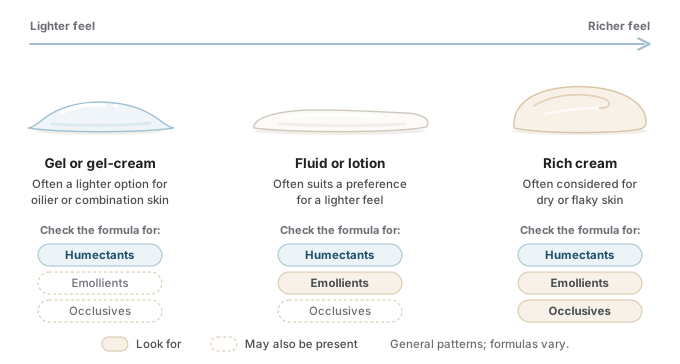
| Format | Often a good fit for | What to check in the formula |
|---|---|---|
| Gel or gel-cream | Oilier or combination skin, warmer weather, a preference for a lighter feel | Something beyond water-binding: a gel isn’t automatically oil-free, and it may need an emollient or silicone to slow water loss |
| Fluid or lotion | Normal to combination skin, a preference for a lighter feel | A humectant plus emollients |
| Rich cream | Dry or flaky skin, evenings, cold weather | Humectants alongside emollients and occlusives |
These are starting points: textures vary a lot within each name, so a brand’s ‘gel’ and another’s ‘cream’ can overlap.
Three formulas showing different choices
These examples show how to apply the process. Each illustrates a different format and combination of ingredients.
Byoma Moisturising Gel Cream
Byoma Moisturising Gel Cream combines glycerin with Ceramide NP, cholesterol, stearic acid and oleic acid. It also lists niacinamide and panthenol. Byoma describes its gel-cream texture as weightless and cooling.
It shows you don’t need a heavy cream to get those three lipid types. It’s worth a look if your skin is combination or oilier but still gets tight and reactive.
La Roche-Posay Toleriane Dermallergo Soothing Fluid
The UK manufacturer’s professional ingredient list for La Roche-Posay Toleriane Dermallergo Soothing Fluid includes glycerin, shea butter and squalane, without a listed ceramide.
This is the simplest route of the three: a humectant and two emollients in a fluid, with the shortest list here at 18 ingredients. A shorter list isn’t safer in itself, but it means fewer variables if you’re still working out what your skin reacts to. As a fluid, it’s also a lighter daytime option.
CeraVe Moisturising Cream
CeraVe Moisturising Cream for Dry to Very Dry Skin lists glycerin, petrolatum and dimethicone alongside ceramides and cholesterol. CeraVe describes it as a rich cream for face and body.
It’s a richer option to consider for dry or flaky skin. The larger face-and-body pack also illustrates the unit-price point below: compare unit prices with a small facial jar rather than shelf prices.
Make the choice practical
Compare pack sizes as well as prices. Unit prices help when one option is a small facial product and another is a larger face-and-body cream; compare them where the packs use the same units, since some larger tubs are sold by weight (g) rather than volume (ml). Check the current price on the product page or retailer; discounts and stock change too often to make them part of this guide.
Choose something you can afford to use regularly. A premium price doesn’t establish better performance, and a longer ingredient list isn’t automatically better or worse.
You also don’t need a separate serum to ‘complete’ every moisturiser. Work out what the formula already covers before adding another step.
What about a moisturiser with SPF?
Check UVA protection as well as the SPF number. The British Association of Dermatologists notes that SPF moisturisers can fall short through thin application or limited UVA protection; it recommends sunscreen of at least SPF 30 with UVA protection. A separate sunscreen can make that step easier to manage. If you want a mineral option, browse our screened SPF selection. Our screen excludes selected chemical UV filters – oxybenzone, octinoxate and avobenzone – not all chemical filters. Whichever format you choose, follow its application and reapplication directions. Our guide to skincare order explains why sunscreen goes last.
Introduce one product, then pay attention
Try one new product at a time, keeping the rest of your routine familiar. That makes it easier to work out what changed.
For a home check, the American Academy of Dermatology suggests applying the normal amount to a small area twice daily for seven to ten days, for example on the underside of your arm or the bend of your elbow. This can help reveal a reaction before wider use. It doesn’t guarantee tolerance on the face, and it isn’t the clinical patch testing used to investigate an allergy.
For routine application, moisturise after washing while skin is slightly damp, when occlusive ingredients work best (Purnamawati et al., 2017). Adjust use to your skin’s needs and the product directions, rather than adding layers simply because they contain different ingredients.
If a new moisturiser causes a reaction, stop using it. Seek advice if irritation persists, worsens or has no clear cause; for emollient-related reactions, the NHS recommends speaking to a GP, nurse or pharmacist. You don’t need to keep buying replacements to solve a problem you haven’t identified.
Your choosing checklist
Before you buy, ask:
- Does the format suit my current needs and preferences?
- Have I checked my known triggers and the full ingredient list?
- Does the formula cover water binding and softening or reducing water loss?
- Are extra ingredients serving a purpose, rather than just increasing the count?
- Can I afford to use it regularly and introduce it on its own?
Use those answers to narrow the field, then browse our screened moisturisers for the current selection and fuller formula assessments.
Sources
- Misery L, Ständer S, Szepietowski JC, et al. (2017). Definition of sensitive skin: an expert position paper from the Special Interest Group on Sensitive Skin of the International Forum for the Study of Itch. Acta Dermato-Venereologica, 97(1), 4–6. DOI: 10.2340/00015555-2397.
- Purnamawati S, Indrastuti N, Danarti R, Saefudin T (2017). The role of moisturizers in addressing various kinds of dermatitis: a review. Clinical Medicine & Research, 15(3–4), 75–87. DOI: 10.3121/cmr.2017.1363.
- American Academy of Dermatology. How to pick the right moisturizer for your skin. Updated 25 January 2022.
- American Academy of Dermatology. How to test skin care products. Updated 10 August 2021.
- American Academy of Dermatology. Moisturizer: Why you may need it if you have acne.
- NHS. Emollients. Reviewed 24 October 2023.
- US Food and Drug Administration. “Alcohol Free”. Used for the fatty-alcohol distinction, not UK labelling law.
- Sub-Working Group on Claims. (2017). Technical document on cosmetic claims, version 3 July 2017, Annex IV: Hypoallergenic claim. Best-practice guidance, not a legally binding rule.
- Regulation (EC) No 1223/2009 on cosmetic products, Annex III, as it applies in Great Britain. legislation.gov.uk. Used for the fragrance-allergen labelling thresholds.
- British Association of Dermatologists. Sun Protection Fact Sheet, including the section on SPF in moisturisers.
The published UK ingredient lists used for these examples were rechecked on 19 October 2026: Byoma Moisturising Gel Cream, Cult Beauty; Toleriane Dermallergo Soothing Fluid, L’Oréal UK professional shop; and CeraVe Moisturising Cream, L’Oréal UK professional shop. Byoma’s format description was checked against Byoma UK. These are screening examples, not evidence that a named finished product achieves a clinical result.