
Chemical UV filters: oxybenzone, octinoxate, avobenzone
Three organic UV filters with different concerns — grouped here because they sit outside the Skincare Clarity curation for related but distinct reasons.
Three organic UV filters appear together on this page because the Skincare Clarity curation excludes all three — but the case against each is different, and we want to be straightforward about that. Oxybenzone has the strongest case: years of regulatory restriction, recent endocrine-disruptor concern in European substance-evaluation records, and high systemic absorption in human studies. Octinoxate has a related but more precautionary profile, with high systemic absorption, environmental scrutiny, and no current UK or EU finding that compliant octinoxate-containing products are unsafe. Avobenzone is a different case altogether: the concern is primarily photo-instability and the cumulative reactivity profile of organic-filter systems in reactive skin, rather than endocrine disruption.
On this page
The Red List Verdict
These three filters are among the better-known organic UV filters encountered in UK and EU sunscreens, especially in older or more conventional formulations. They work — they absorb UV radiation and can deliver high SPF and broad-spectrum protection in lightweight, cosmetically elegant formulas. The case for excluding them from a reactive-skin curation rests on three considerations.
First, several widely used organic filters — including oxybenzone, octinoxate, and avobenzone — have been shown in FDA-sponsored studies to be absorbed through the skin into systemic circulation at levels above the FDA threshold for additional safety testing. Second, regulatory bodies have restricted oxybenzone significantly in recent years on endocrine-disruption grounds, with further regulatory scrutiny ongoing. Third, organic filters are more often implicated in stinging, contact dermatitis, and photoallergic reactions than mineral filters, especially in sensitive-skin and dermatology discussions — a distinction that matters more for the reactive-skin audience this curation serves than for general consumers.
Mineral filters — zinc oxide and titanium dioxide — provide an alternative class of UV protection that does not share these concerns, and the curation defaults to them for sun protection.
What are chemical UV filters?
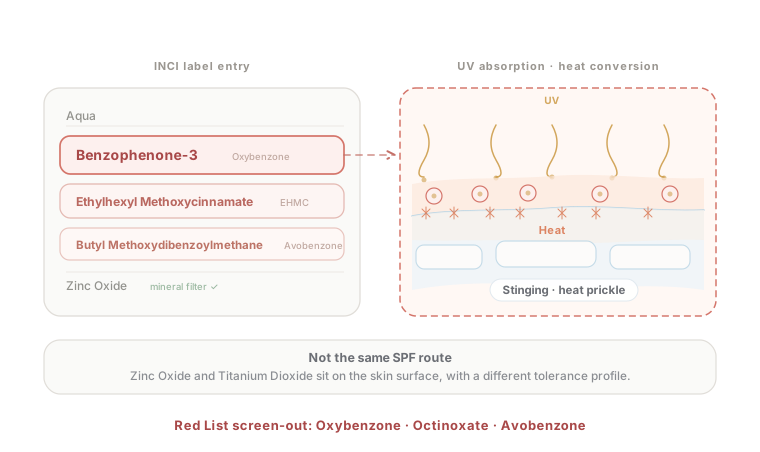
Sunscreen ingredients fall into two broad classes. Mineral filters — zinc oxide and titanium dioxide — are inorganic compounds that sit on the skin and provide UV protection through a combination of reflection, scattering, and absorption. Chemical filters — sometimes called organic filters — are carbon-based molecules that absorb UV radiation and dissipate it as a small amount of heat. Most modern sunscreens use one or the other, or a combination of the two.
Chemical filters have advantages in formulation. They are typically lighter in texture, easier to incorporate into elegant aesthetics, and can deliver high SPF values without the white cast historically associated with mineral filters. They are the dominant class in mainstream UK and EU sunscreens. The three covered on this page are among the better-known and historically common organic filters: oxybenzone (Benzophenone-3, sometimes written BP-3), octinoxate (Ethylhexyl Methoxycinnamate or EHMC), and avobenzone (Butyl Methoxydibenzoylmethane).
Chemical UV filters as a reactive-skin tolerance concern
Oxybenzone — why it is on our Red List
Oxybenzone (Benzophenone-3) is the most regulated of the three filters covered here, and the case against it is the most settled.
The EU Scientific Committee on Consumer Safety concluded in 2021 (SCCS/1625/20) that oxybenzone is not safe for the consumer at the previously permitted maximum concentration of 6% in body sunscreens, on the basis of potential endocrine-disrupting properties. EU Regulation 2022/1176 implemented that finding by narrowing the permitted uses and concentrations: oxybenzone remains permitted up to 6% in face, hand, and lip products, but is more restricted in other product types and excluded from some spray formats. The UK adopted aligned restrictions in 2025 (Statutory Instrument 2025 No. 901), with restrictions applying from 21 January 2026 and the transition for products already placed on the market ending on 21 July 2026.
The regulatory picture has continued to develop. In 2025, ECHA substance-evaluation records identified oxybenzone as raising endocrine-disruptor concerns for both human health and the environment, following a decade-long evaluation led by Denmark, with further regulatory scrutiny ongoing.
A separate concern is systemic absorption. The FDA-sponsored studies published in JAMA in 2019 and 2020 found that oxybenzone is absorbed through the skin into the bloodstream after typical sunscreen application, reaching plasma concentrations many times above the FDA’s threshold for requiring further toxicological assessment. The FDA has not concluded that oxybenzone is unsafe — it has concluded that the existing safety database is inadequate given the absorption levels observed.
For a reactive-skin curation, the combination of regulatory restriction, ongoing regulatory scrutiny, high systemic absorption, and a comparatively high rate of contact and photoallergic reactions makes oxybenzone an unambiguous exclusion.
Octinoxate — why it is on our Red List
Octinoxate (Ethylhexyl Methoxycinnamate, EHMC) is one of the most widely used organic UVB filters globally and is permitted in the EU and UK at concentrations up to 10%.
The SCCS reviewed octinoxate’s safety in 2024 and 2025 as part of the EU’s priority assessment of potential endocrine disruptors. The current SCCS position is that octinoxate shows estrogenic and weak anti-androgenic activity in the evidence reviewed, but is safe as a UV filter up to 10% in the specified cosmetic categories because the calculated margin of safety is high. Octinoxate also sits alongside oxybenzone on environmental ban lists in Hawaii and parts of the Caribbean.
Octinoxate was also among the organic filters identified in the 2020 JAMA sunscreen absorption study. It was detected in blood plasma at concentrations well above the FDA threshold, on a comparable basis to oxybenzone.
The Skincare Clarity exclusion of octinoxate is more precautionary than the oxybenzone exclusion. It is editorial rather than based on a current UK or EU finding that compliant octinoxate-containing products are unsafe: the current regulatory consensus is that it is safe at permitted levels. The exclusion rests instead on its high systemic absorption profile, the continued scrutiny of some organic UV filters, and the higher reactivity profile of organic-filter systems in reactive skin compared with mineral alternatives. Excluding it is consistent with the curation’s broader pattern: where consumer concern is well-established, systemic exposure is meaningful, and a viable alternative class exists, the curation defaults to the alternative.
Avobenzone — why it is on our Red List
Avobenzone (Butyl Methoxydibenzoylmethane) is the most editorially nuanced of the three. It is the most widely used organic UVA filter in the EU and UK, and unlike oxybenzone and octinoxate, it has not been the subject of significant endocrine-disruptor concern.
The exclusion rests on two different considerations. First, avobenzone is photo-unstable. On its own, it degrades when exposed to UV light, losing protective capacity over the course of a day’s wear and producing degradation products that are one reason formulators rarely use it without stabilisers. Modern formulations stabilise avobenzone by pairing it with other organic filters — most commonly octocrylene or Tinosorb S — but the underlying instability remains a structural property of the molecule.
Second, avobenzone was one of the organic filters shown in the 2019–2020 FDA sunscreen absorption studies to reach blood plasma concentrations above the FDA threshold for additional safety testing, alongside oxybenzone and, in the 2020 study, octinoxate.
The exclusion of avobenzone is the most editorial of the three. It reflects the curation’s general preference for the mineral-filter class in sun protection — a class that does not require the same photostabilisation strategy, has minimal dermal penetration on intact skin, and is associated with lower rates of contact reaction in reactive skin. As with octinoxate, the alternative is structural: the curation favours an entirely different category of UV protection rather than a different organic filter.
The reactive-skin angle
A point worth stating directly: the case against organic UV filters in a reactive-skin curation is not solely about systemic absorption or regulatory pressure. Organic filters are also more frequently reported as the cause of stinging on application, particularly around the eyes, contact dermatitis, and photoallergic reactions than mineral filters. For users with rosacea, eczema-prone skin, post-procedure skin, or skin that has become reactive after a flare, this is often the most practically relevant difference between the two filter classes — and the one most directly aligned with the curation’s audience.
What to look for on a label
On a UK INCI list, the three filters appear under their EU and UK regulatory names:
- Benzophenone-3 (Oxybenzone) — permitted up to 6% in face, hand, and lip products excluding spray formats, up to 2.2% in body products, and up to 0.5% for formula protection under current UK and EU regulation
- Ethylhexyl Methoxycinnamate (Octinoxate, EHMC) — permitted at up to 10%
- Butyl Methoxydibenzoylmethane (Avobenzone) — permitted at up to 5%
Two related organic filters worth flagging while reading sunscreen INCI lists: Octocrylene, commonly paired with avobenzone as a stabiliser, remains permitted within UK and EU limits after SCCS review, but has had separate scrutiny around benzophenone impurity or degradation and environmental impact; Homosalate has had its EU permitted concentration significantly reduced in recent years on endocrine-activity grounds. Neither is on the Skincare Clarity hard exclusion list, but a sunscreen built around both is structurally an organic-filter formula and outside the curation’s preferred category.
A practical signal: a sunscreen that lists Zinc Oxide or Titanium Dioxide as its only active filters — with no Benzophenones, Cinnamates, Methoxydibenzoylmethane, Octocrylene, Homosalate, or other organic filters — is built on the mineral-filter class.
What to use instead
For reactive skin, the clearest alternative to organic UV filters is the mineral-filter class. zinc oxide is the broadest-spectrum mineral filter, providing UVA and UVB protection across the full spectrum and tolerated well by reactive and post-procedure skin. titanium dioxide provides strong UVB and shorter-wavelength UVA coverage and is often paired with zinc oxide for a fuller protective range. iron oxides are related mineral pigments used in tinted SPF formulations, where they can additionally help reduce visible-light exposure — particularly relevant for users with melasma, post-inflammatory pigmentation, or photosensitive conditions.
A well-formulated mineral SPF for reactive skin typically pairs the active filters with barrier-supporting and humectant ingredients such as glycerin, panthenol, niacinamide, or ceramides, and avoids fragrance and drying alcohols in the underlying base. The combination is the structural pattern worth scanning for when reading a sunscreen label.