Parabens
A family of preservatives where the scientific picture is more settled than the marketing story — and where the Skincare Clarity exclusion is honestly precautionary rather than evidence-driven.
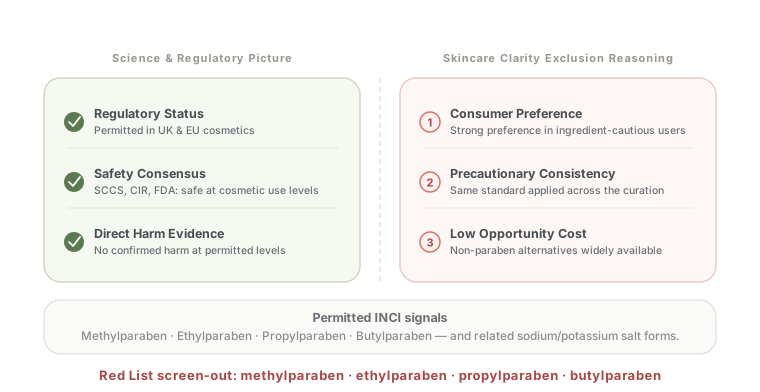
Parabens are the most editorially complicated entry on the Skincare Clarity Red List, and we want to be straightforward about why. The exclusion is not driven by a strong scientific case against the permitted parabens. Multiple regulatory reviews — including the EU Scientific Committee on Consumer Safety, the US Cosmetic Ingredient Review, and the FDA — have concluded that methylparaben, ethylparaben, propylparaben, and butylparaben at the concentrations permitted in cosmetics are safe for general use. The exclusion is precautionary, reflects strong ingredient-cautious consumer preference, and is consistent with the curation’s broader approach to ingredients where consumer concern outpaces consensus. The page below walks through what the evidence actually shows so that readers can hold the line themselves if they choose to.
The Red List Verdict
Parabens are a family of preservatives — esters of para-hydroxybenzoic acid — used in cosmetics since the 1920s. They are highly effective at low concentrations, contribute to the safe shelf life of many products, and have been more thoroughly studied than most preservatives in current use. Five parabens (isopropyl, isobutyl, pentyl, benzyl, phenyl) are banned in EU and UK cosmetics as of 2014 due to insufficient safety data. Four (methylparaben, ethylparaben, propylparaben, butylparaben) remain permitted under defined concentration limits and are considered safe by current regulatory consensus.
Skincare Clarity excludes parabens as a class, including the permitted four. We do this knowingly and on precautionary grounds. The scientific case against methylparaben and ethylparaben at typical use concentrations is genuinely weak; the case against propyl- and butylparaben is more nuanced but still does not amount to a safety consensus. Our exclusion reflects a strong preference within the ingredient-cautious skincare audience for paraben-free formulas, the precautionary line we take with ingredients where consumer concern is well-established, and the practical reality that modern non-paraben preservation alternatives are widely available and commonly used in well-tolerated reactive-skin formulas. We would rather be honest about the editorial reasoning than pretend the science is more settled than it is.
Parabens — an honest audit
What are parabens?
Parabens are esters of para-hydroxybenzoic acid (also called PHBA), a small organic molecule that occurs naturally in some plants, fruits (notably blueberries and some other berries), and human metabolism. The various parabens differ in the alcohol group attached to the PHBA core: methylparaben is the methyl ester, ethylparaben the ethyl ester, propylparaben the propyl ester, and so on. The longer the carbon chain, the more lipophilic the molecule and the higher its activity in some biological assays.
Their function in cosmetics is straightforward. They prevent the growth of bacteria, yeast, and mould in water-based formulations, extending shelf life and protecting consumers from microbial contamination. They are effective across a wide pH range, typically used at low concentrations (well below 1% total), and historically were used in mixtures across the four most common forms because that combination provides broader-spectrum coverage than any single paraben alone.
Some parabens also appear outside cosmetics. In EU food-additive regulation, methylparaben and ethylparaben and their sodium salts have authorised uses, while propylparaben and its sodium salt were withdrawn after EFSA could not establish an acceptable daily intake. Parabens are also used in some pharmaceutical products. Cosmetic and personal-care products remain an important exposure route, so the point is not that cosmetic exposure is negligible, but that parabens are encountered across more than one regulated category.
Where the public concern came from
The modern public concern about parabens traces largely to a single 2004 study by Darbre and colleagues, which detected paraben residues in breast cancer tumour tissue. The study did not compare paraben concentrations in tumour tissue versus healthy breast tissue, did not establish a causal link between paraben exposure and cancer, and used a small sample size that limited what could reasonably be inferred from the findings. The authors themselves were careful in their conclusions; the popular and marketing reception of the study was much less so.
In the years that followed, ‘paraben-free’ became one of the most commercially successful claims in the personal care market, often paired with vague suggestions about endocrine disruption and breast cancer risk. The marketing position was reinforced by some early in vitro and rodent studies showing weak estrogenic activity of certain parabens — particularly the longer-chain ones. The activity is real but very weak: methylparaben’s estrogenic potency is on the order of tens of thousands of times weaker than estradiol, and the longer-chain parabens, while more active, still operate at orders of magnitude below the body’s endogenous estrogen exposure.
The EU has since taken a notable position on this. Under EU cosmetic-claims guidance, ‘free from parabens’ is treated as problematic because it can imply that permitted parabens are unsafe, which regulators consider misleading or denigrating to lawful ingredients. UK industry guidance takes the same broad position, although the claim still appears widely in the market.
What the evidence actually shows
The scientific picture is more settled than the marketing story suggests, but it is also more granular than a simple ‘parabens are safe’ reply.
For methylparaben and ethylparaben — the shorter-chain parabens, by far the most commonly used — the regulatory consensus is reassuring. The SCCS most recently reviewed methylparaben in late 2023 and early 2024 (SCCS/1652/23) and confirmed safety at concentrations up to 0.4% as a single ester, or up to 0.4% as part of a mixture not exceeding 0.8% total parabens. The CIR has reached comparable conclusions. The dermal absorption is low, the metabolism rapid, and the margin of safety at typical cosmetic use levels is wide.
For propylparaben and butylparaben — the longer-chain forms — the picture is more cautious and now more nuanced. EU regulation (Commission Regulations 358/2014 and 1004/2014) reduced their permitted maximum concentration from 0.4% to 0.14% specifically because of more conservative margins of safety for the longer-chain parabens. Propyl- and butylparaben are also prohibited in leave-on products designed for the nappy area of children under three. Propylparaben remains considered safe at the 0.14% limit under SCCS/1623/20. For butylparaben, the 2025 children’s-exposure opinion (SCCS/1674/25) found that 0.14% across all assessed cosmetic products in combination is not safe for children aged 0.5–10 years when aggregate exposure is considered. This does not overturn the page’s main point for adult general use, but it does make the butylparaben picture more cautious in children’s product categories.
The five parabens that the EU banned outright in 2014 — isopropylparaben, isobutylparaben, pentylparaben, benzylparaben, phenylparaben — were not banned because of evidence of harm. They were banned because the available data was insufficient to establish safety, and the regulator took the precautionary route. That distinction matters: bans on insufficient-data ingredients are not the same as bans on demonstrably harmful ingredients.
The 2004 Darbre study has been followed by considerable further research. To date, no regulatory body in any major market has concluded that parabens at typical cosmetic use concentrations cause cancer, are clinically meaningful endocrine disruptors, or pose a measurable safety risk to the general consumer.
Why parabens are on our Red List
Skincare Clarity excludes parabens, including the four still permitted in UK and EU cosmetics, for three reasons that we want to state plainly.
First, the audience preference is strong and consistent. Many ingredient-cautious and reactive-skin users actively prefer paraben-free formulas. A curation built around this audience that retained paraben-containing products would be working against an established and widely held consumer preference, even where that preference is more cautious than the science requires. We respect the preference rather than override it.
Second, the precautionary line is consistent with our approach elsewhere in the curation. The Skincare Clarity Red List excludes several ingredients on partial-evidence grounds where consumer concern is well-established and viable alternatives exist. Treating parabens differently — admitting them on the grounds that ‘the evidence is not as bad as people think’ — would be inconsistent. The same logic that excludes them is the logic that ensures the curation is reliably aligned with reactive-skin user expectations.
Third, practical non-paraben preservation alternatives are widely available and increasingly used in modern cosmetic formulation. Phenoxyethanol-based systems, organic acid systems, and multi-functional preservation built around pentylene glycol or similar molecules now preserve many well-formulated reactive-skin products. The opportunity cost of excluding parabens from the curation is genuinely low.
What we will not do is overstate the scientific case. Methylparaben at 0.2% in a moisturiser is not going to harm a healthy adult. The exclusion sits on different reasoning, and that reasoning is honest.
What to look for on a label
On a UK INCI list, the four permitted parabens appear under their direct names:
- Methylparaben — the most common, smallest molecule, strongest safety record
- Ethylparaben — also widely used, comparable safety profile
- Propylparaben — restricted to 0.14% maximum, prohibited in nappy-area products for under-threes
- Butylparaben — same baseline cosmetic restrictions as propylparaben, with a more cautious 2025 SCCS aggregate-exposure picture for children’s product categories
Related sodium and potassium salts — Sodium Methylparaben, Potassium Ethylparaben, Sodium Butylparaben, and similar — are all listed in EU Annex V and are functionally equivalent to their parent ester for label-reading purposes.
The five banned parabens — Isopropylparaben, Isobutylparaben, Pentylparaben, Benzylparaben, Phenylparaben — should not appear on UK or EU products marketed in this region. They may still appear on imports from regions without equivalent restrictions; checking the INCI on imports remains worthwhile.
A note on the ‘paraben-free’ claim: under EU cosmetic-claims guidance, and aligned UK industry guidance, this claim is generally treated as non-compliant where it implies permitted parabens are unsafe. The claim continues to appear widely, particularly on smaller brands and direct-to-consumer products. Its presence on a label is not by itself a quality signal.
What to use instead
The alternative to parabens is a different preservation system rather than a different active ingredient. Modern reactive-skin formulas typically use one of three approaches: phenoxyethanol at low concentration (often 0.5–1%, often paired with ethylhexylglycerin); organic acid systems built around sodium benzoate, potassium sorbate, and benzoic acid in a slightly acidic formula; or multi-functional ingredients like pentylene glycol, propanediol, or 1,2-hexanediol that contribute preservative activity alongside their primary humectant or solvent role. None of these are individually on the Skincare Clarity Green List, but they are the preservation chemistries most commonly seen in well-tolerated formulas.
The product categories where paraben replacement is most relevant — moisturisers, serums, cleansers, and body products — overlap heavily with the reactive-skin curation. Cleansers built around cocamidopropyl betaine and decyl glucoside, and moisturisers built around ceramides, glycerin, panthenol, and squalane, tend to use the non-paraben preservation systems described above rather than parabens, and the formula composition as a whole tends to read more clearly as reactive-skin-appropriate.