
SLS / SLES — Sodium Lauryl Sulfate and Sodium Laureth Sulfate
Two related but not equivalent surfactants — and why both sit outside the Skincare Clarity curation.
SLS has a strong reputation as a harsh ingredient, and the reputation is largely earned: in dermatology research, it is commonly used as a standard irritant to create controlled skin reactions. SLES is the related but meaningfully gentler version, often positioned in mainstream cleansers as a ‘milder’ alternative to SLS. For reactive skin, both sit outside the curation, but for different reasons and with different levels of confidence.
On this page
The Red List Verdict
SLS and SLES are both anionic surfactants — cleansing agents that build foam and lift oil from skin or hair. SLS is the harsher of the two and is used in dermatology research as a standardised irritant control. SLES is ethoxylated SLS — chemically modified to be larger, milder, and less penetrating. SLES is genuinely gentler, but still on the harsher end of the surfactant spectrum for reactive skin.
Skincare Clarity excludes both. The exclusion of SLS is straightforward and evidence-led. The exclusion of SLES is editorial rather than safety-driven: gentler surfactant chemistries — non-ionic and amphoteric systems built around cocamidopropyl betaine and decyl glucoside — clean effectively without raising the same risk for the most easily irritated users. Once those alternatives exist on shelf, there is no compelling reason to stay with SLES in a reactive-skin curation.
What are SLS and SLES?
Sodium Lauryl Sulfate (SLS) and Sodium Laureth Sulfate (SLES) are anionic surfactants — cleansing molecules that bind to both oil and water, lifting dirt, oil, and product residue away from skin or hair when rinsed. They are the foam-builders in many mainstream body washes, shampoos, foaming face cleansers, and toothpastes.
The two are related but not equivalent. SLS is the older, more aggressive form, derived from lauric acid (typically sourced from coconut or palm oil) and processed into a strong, low-cost cleansing surfactant. SLES is SLS that has been ethoxylated — a chemical step that adds an ether group to the molecule, making it larger, milder, and less penetrating into the skin. In direct comparative testing, SLS produces a pronounced skin reaction; SLES produces a noticeably milder one.
Neither is ‘natural’ or ‘synthetic’ in any clean sense. Both may start from plant-derived fatty feedstocks and are heavily processed into their finished surfactant form. Naming the production route accurately matters more than positioning either as one or the other.
SLS / SLES as an over-cleansing concern
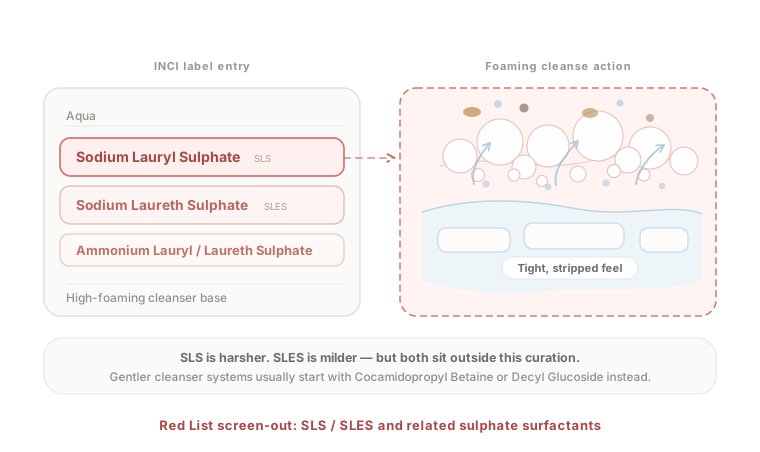
Why SLS and SLES are on our Red List
SLS is so reliably irritating under standardised test conditions that researchers often use it as an irritant control when studying skin barrier disruption or the protective effect of other ingredients — a role it has played in dermatology and formulation research for decades. That is not a marketing claim against the ingredient; it is how the formulation science community actually uses it.
For users with intact, non-reactive skin, SLS in a brief rinse-off context — toothpaste, body wash, hand soap — is generally not a meaningful problem. The contact time is short, the barrier is intact, and irritant potential is dose- and time-dependent. For reactive skin or a compromised barrier, the threshold for reaction is lower, and SLS reliably crosses it. Tightness, stinging, residual dryness, and barrier disruption measurable as transepidermal water loss are the most commonly reported effects.
SLES is the more nuanced judgement call. It is genuinely milder than SLS in direct comparative testing, and many sensitive-skin users tolerate SLES-based cleansers without incident. The exclusion is editorial: for a curation built around the most tolerated cleansing systems available, SLES is still not where we choose to draw the line. Studies comparing SLS, SLES, and alkyl polyglucoside surfactants — the family that decyl glucoside belongs to — consistently show that the polyglucosides produce almost no detectable irritation under the same conditions where SLS produces strong reactions and SLES produces moderate ones. Once that gentler tier of chemistry exists in the market, it becomes the appropriate starting point for reactive skin.
A separate concern with SLES is the potential presence of 1,4-dioxane as a manufacturing by-product of the ethoxylation process. This is well-controlled in most regulated markets, including the UK and EU, and is not the primary reason for the Skincare Clarity exclusion — but it is worth knowing, and it is one more reason to prefer surfactant systems that do not require ethoxylation in the first place.
What to look for on a label
On a UK INCI list, SLS and SLES appear under several closely related names:
- Sodium Lauryl Sulfate (often written Sodium Lauryl Sulphate in UK consumer copy — the same molecule)
- Sodium Laureth Sulfate (often written Sodium Laureth Sulphate; the ‘-eth-’ indicates ethoxylation)
- Ammonium Lauryl Sulfate, Ammonium Laureth Sulfate (related, similar profile)
- TEA Lauryl Sulfate (less common, similar profile)
These are most often found as the primary surfactant in foaming face cleansers, shampoos, body washes, and any product marketed as ‘deep cleansing’ or ‘high-foaming’. Their position high on the INCI list — usually within the first few ingredients after water — signals that the formula is built around them rather than incorporating them as a minor component.
A useful inverse signal: if a cleanser lists Cocamidopropyl Betaine or Decyl Glucoside as its primary surfactants, with no Sodium Lauryl or Sodium Laureth derivatives present, the formula has been built on the gentler end of the spectrum.
What to use instead
For reactive skin, the goal is a cleanser that removes oil, sunscreen, and grime without leaving the skin feeling tight, squeaky, or stripped after rinsing.
A stronger signal of a gentler cleansing system on an INCI list is the use of milder surfactants such as cocamidopropyl betaine, decyl glucoside, or related low-stripping blends as the primary cleansing base. These are usually paired with humectants like glycerin and barrier-supporting or calming ingredients such as panthenol, allantoin, or Oat Family extracts. The combination cleans effectively while leaving the skin’s lipid and water balance closer to where it started — which, for reactive skin, is the entire point of a cleanser.