
Choose with confidence
How to choose a gentle cleanser for sensitive skin
Read the cleansing system, compare gel, cream and balm formats and wash in a way your skin tolerates.
On this page
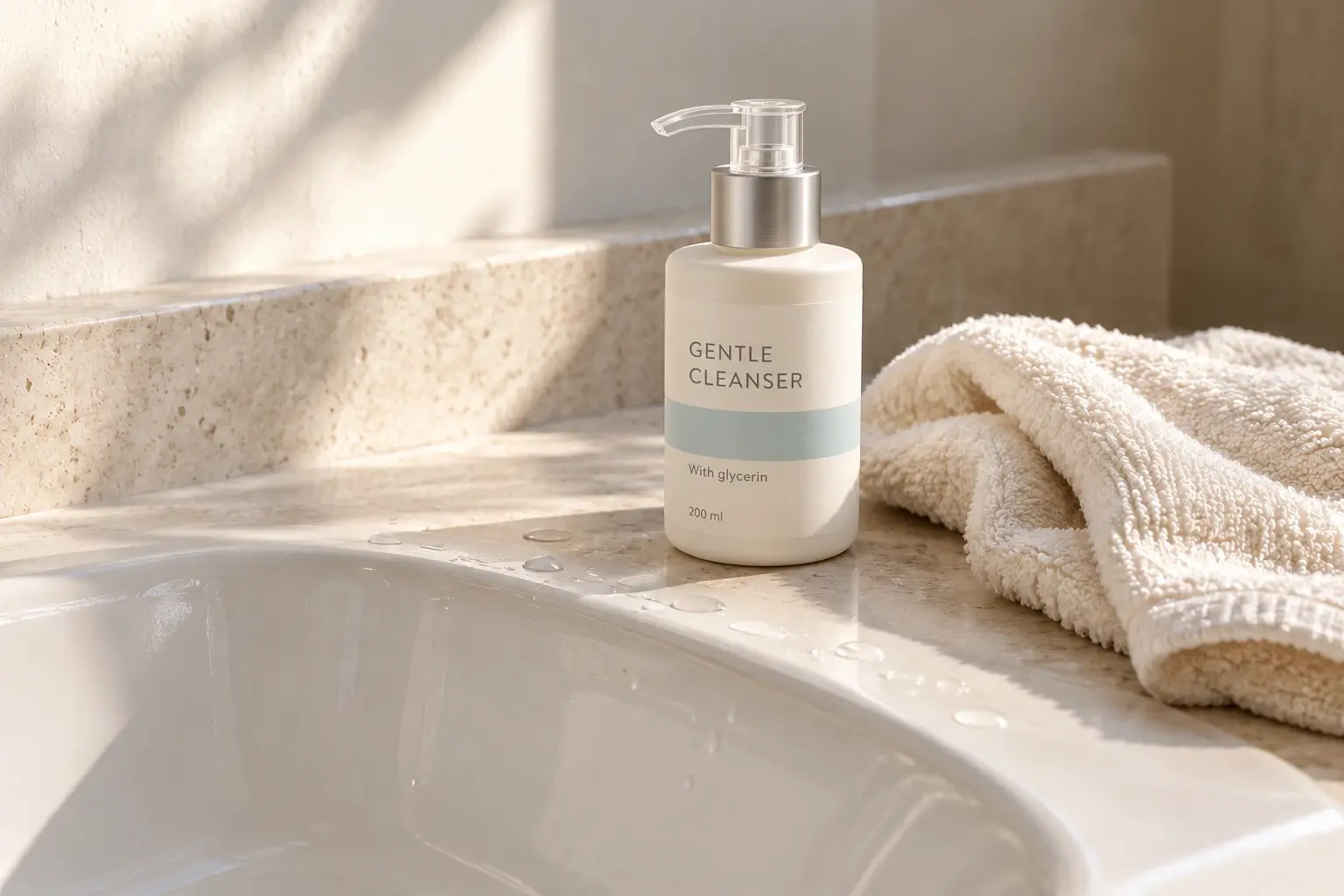
A cleanser has a narrow job: lift off sunscreen, make-up, sweat and oil, then rinse away without taking too much else with it. For sensitive skin, the second half is the hard part. The same wash can feel fine on one face and leave another tight and stinging. This guide shows how to choose by what’s actually in the formula and how it cleans, rather than by foam, scent or the word ‘gentle’ on the front.
Clarity Summary
- Match the cleanser to what you wear. Water-resistant sunscreen and long-wear make-up can need more cleansing than a morning wash.
- Read the whole cleansing system. Surfactants and emulsifiers work together; one name rarely tells the full story.
- Treat extras as a bonus. A cleanser is rinsed off, so it doesn’t replace a leave-on moisturiser.
- Trust the after-feel. Skin that feels tight straight after washing is a signal worth acting on.
Start with what your cleanser has to remove
Before comparing products, think about what you’re washing off.
- Water-resistant sunscreen or long-wear make-up can be harder to shift. Check the product’s own removal directions. A balm or oil cleanser is designed to dissolve this kind of oily residue, and some people follow it with a second, water-based cleanser.
- An ordinary evening wash after a light moisturiser and sunscreen may need only a gentle cream or gel.
- A morning wash has very little to remove. Some people with dry, reactive skin find water alone is enough.
For many people, one well-tolerated cleanser that removes what they actually wear is enough. A balm, or a second cleanse, is useful on days with more to remove rather than a daily rule.
Read the cleansing system, not one name
Cleansers differ a lot in how hard they are on the skin barrier, depending on the surfactants used, the pH and the formula as a whole (Ananthapadmanabhan et al., 2004). So it helps to look at the cleansing ingredients as a group.
The ones we screen out. SLS and SLES, Sodium Lauryl Sulfate and Sodium Laureth Sulfate, are on our Red List. Watch for look-alike names that aren’t the same molecule. Sodium Lauryl Sulfoacetate isn’t SLS, and Disodium Laureth Sulfosuccinate isn’t SLES.
Milder surfactants. Cocamidopropyl betaine and decyl glucoside are common in gentler foaming and jelly cleansers. Cocamidopropyl betaine does carry a known contact-allergy risk for a small number of people, so if you’ve reacted to it before, check for it.
Non-foaming and balm cleansers still use cleansing agents. A cream or balm that doesn’t lather isn’t necessarily free of surfactants. Emulsifiers and mild surfactants let oils and residue mix with water so they rinse away. In a cream cleanser these might include PEG-40 Stearate or Polysorbate 20. Fatty alcohols such as Cetearyl Alcohol often sit alongside them, but their main jobs are to give the cream its body and leave skin feeling softer, not to do most of the cleaning. In a cleansing balm, look for emulsifiers such as PEG-20 Glyceryl Triisostearate or polyglyceryl esters alongside the oils.
So foam on its own doesn’t prove a cleanser is harsh, and the absence of foam doesn’t mean nothing is doing the cleaning. Read the list, and pay attention to how your skin feels afterwards.
What else the formula carries
Many cleansers for sensitive skin add glycerin, ceramides, oat or other comfort and barrier ingredients. These are good signs about how a formula has been put together, and glycerin in particular can help offset some of the dryness washing can cause.
Keep expectations proportionate, though. A cleanser spends a short time on your skin before it’s rinsed off. Treat ceramides or oat in a cleanser as a bonus, not as a replacement for a moisturiser that stays on.
Gel, cream or balm?
| Format | How it cleans | Often suits | Worth checking |
|---|---|---|---|
| Gel or jelly | Usually a blend of surfactants that lathers | Normal or combination skin, people who like foam | Which surfactants lead the list; any you know you react to |
| Cream or milk | Emulsifiers and mild surfactants, often with conditioning ingredients and little or no lather | Dry or easily irritated skin; everyday use | Whether it removes your sunscreen; how skin feels after rinsing |
| Balm or oil | Oils and waxes dissolve residue; emulsifiers help it rinse | Removing water-resistant sunscreen or long-wear make-up, often as a first cleanse | Any oils you avoid, including nut-derived oils; whether you need a second cleanse |
Three cleansers, three approaches
These three screened cleansers show different ways of cleaning gently. They’re examples, not a ranking.
Byoma Creamy Jelly Cleanser
Byoma Creamy Jelly Cleanser is the option for people who like a lather. Byoma says the jelly turns into a rich, creamy lather, and that comes from a blend of surfactants led by cocamidopropyl betaine, the second ingredient. It also includes Sodium Lauryl Sulfoacetate and Disodium Laureth Sulfosuccinate, which aren’t SLS or SLES. Glycerin, Ceramide NP, cholesterol and phytosphingosine follow. Skip it if you know you react to cocamidopropyl betaine, and if it leaves your skin tight, a cream format may suit you better.
CeraVe Hydrating Cleanser
CeraVe Hydrating Cleanser is a non-foaming cream for everyday use on normal to dry, reactive skin. It has no conventional foaming agent: PEG-40 Stearate and, further down, Polysorbate 20 help lift residue so it rinses away, while Cetearyl Alcohol and Behentrimonium Methosulfate add body and conditioning. Glycerin sits second, with three ceramides further down. CeraVe describes it as non-foaming and non-drying. If you wear water-resistant sunscreen, check that it removes it fully; if not, a balm first may help on those days.
The Inkey List Oat Balm Cleanser
The Inkey List Oat Balm Cleanser is built for removing sunscreen and make-up. It’s almost entirely oils and waxes: sweet almond oil first, oat kernel oil third and jojoba esters further down. Emulsifiers in the list let it turn milky and rinse away once water is added. Whether you follow it with a second cleanser depends on what you’re removing and how your skin feels afterwards. Sweet almond oil leads the formula, so it isn’t one for anyone avoiding nut-derived ingredients.
All three passed our screening when we rechecked their UK ingredient lists in October 2026. Individual tolerance still varies, and our screened cleansers include more options at different prices.
How you wash matters too
Even a well-chosen cleanser can feel harsh if it’s used roughly. The American Academy of Dermatology suggests (AAD, face washing 101):
- lukewarm water rather than hot
- your fingertips rather than a washcloth or sponge
- no scrubbing
- patting dry with a soft towel
The AAD suggests washing no more than twice a day, and after sweating. If your skin is dry or reactive and feels tight, try cleanser once a day with a water rinse in the morning, and see how your skin responds. Follow with moisturiser straight after washing, while skin is still slightly damp (AAD, dry skin tips). Our guide to choosing a moisturiser covers that step.
If a cleanser that used to suit you starts to sting, it’s worth asking whether your skin barrier is under strain. Our guide to a damaged skin barrier explains what to look for.
Your choosing checklist
- What does my cleanser need to remove: water-resistant sunscreen and make-up, or just the day?
- Are SLS or SLES on the list, or any surfactant I know I react to?
- Do I prefer lather, or a cream or balm that doesn’t foam?
- Are there oils or extracts I avoid, such as nut-derived oils?
- How does my skin feel straight after rinsing: comfortable, or tight?
Sources
- Ananthapadmanabhan KP, Moore DJ, Subramanyan K, et al. (2004). Cleansing without compromise: the impact of cleansers on the skin barrier and the technology of mild cleansing. Dermatologic Therapy, 17(Suppl 1), 16–25. DOI: 10.1111/j.1396-0296.2004.04S1002.x.
- American Academy of Dermatology. Face washing 101.
- American Academy of Dermatology. Dermatologists’ top tips for relieving dry skin. Updated 2 January 2026.
- Product ingredient lists rechecked 22 October 2026: Byoma Creamy Jelly Cleanser, Cult Beauty; CeraVe Hydrating Cleanser, CeraVe UK; The Inkey List Oat Balm Cleanser, Lookfantastic.
Product ingredient lists and formats come from the linked Skincare Clarity assessments. These are screening examples, not evidence that a named finished product achieves a clinical result. The cocamidopropyl betaine allergy caveat is covered, with its sources, on our cocamidopropyl betaine page.