
Iron oxides
Pigment-based mineral ingredients that add tint to sunscreens and provide visible light protection most SPF filters miss.
Mineral sunscreen has a visibility problem on deeper skin tones — and most SPF filters, mineral or chemical, have a completely separate gap that even the best formulations rarely mention: visible light protection. Strong daylight exposure — and the visible-spectrum light that drives pigmentation on darker skin tones — passes through standard sunscreens largely unaffected. Iron oxides are the ingredient that addresses both problems at once. For users with deeper skin tones or pigmentation concerns, they are not a cosmetic nicety — they are often the ingredient that makes mineral SPF actually work.
On this page
The Clarity Summary
Iron oxides are pigment-based minerals used in skincare for two related purposes: they add tint to sunscreens (reducing or eliminating the white cast of mineral filters) and they provide measurable protection against visible light — a part of the light spectrum that neither zinc oxide, titanium dioxide, nor most chemical filters cover well.
For Skincare Clarity, iron oxides are a specialist ingredient with practical importance for two specific reader groups: users with deeper skin tones who cannot use untinted mineral SPF comfortably, and users with melasma or pigmentation concerns where visible light exposure is part of the underlying trigger. For those readers, iron oxides are often the most important ingredient on the label after zinc oxide itself.
What are iron oxides?
Iron oxides are a family of naturally occurring mineral pigments — iron combined with oxygen in different ratios to produce red, yellow, and black pigments used across skincare, cosmetics, and broader industry. In skincare formulas they appear on INCI lists almost always under numerical identifiers rather than plain names. The three you will encounter most often are:
- CI 77491 — red iron oxide
- CI 77492 — yellow iron oxide
- CI 77499 — black iron oxide
Some labels list them simply as ‘Iron Oxides’ or ‘Iron Oxides (CI 77491, CI 77492, CI 77499)’. All three names refer to the same family, with the specific CI numbers indicating which pigments are present in that particular formulation.
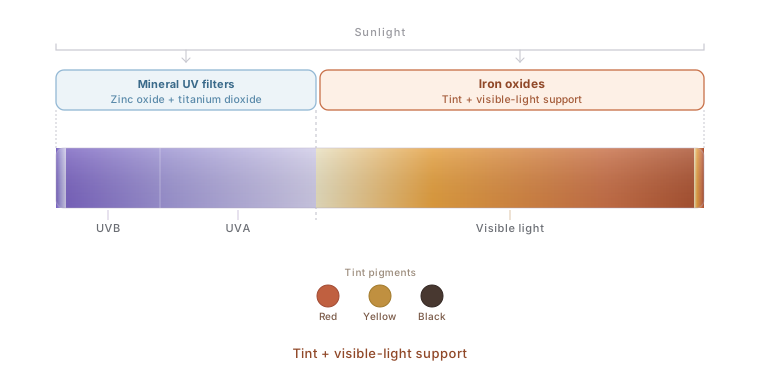
Iron oxides have two distinct but related roles in modern sunscreens. The obvious one is cosmetic tint: the pigments blend with the skin to reduce or eliminate the white cast that mineral filters like zinc oxide and titanium dioxide typically leave behind. The less obvious but often more important role is visible light protection: iron oxides absorb a portion of the visible light spectrum, particularly in the blue and violet bands that contribute to pigmentation on melanin-rich skin.
This second role is the interesting one. Visible light accounts for roughly 40% of the total solar radiation reaching the skin, but most sunscreens — mineral or chemical — do almost nothing to block it. For users whose skin is prone to pigmentation triggered partly by visible light (particularly melasma), iron oxides are one of the very few ingredients that meaningfully addresses this gap.
Iron oxides as visible light support
Why iron oxides matter for sensitive and reactive skin
The practical value of iron oxides divides into two different but related reader scenarios, and being specific about which applies to you matters.
Iron oxides are especially useful when:
- your skin tone makes untinted mineral SPF cosmetically unwearable
- you are prone to melasma or post-inflammatory pigmentation
- you spend significant time under strong visible light exposure
- you have tried untinted mineral SPF and found the white cast a serious obstacle to daily use
- you want the broadest possible UV plus visible-light protection in one product
The strongest honest case for iron oxides is as the ingredient that makes mineral SPF practically usable for readers who otherwise cannot wear it. For deeper skin tones, an untinted zinc-oxide sunscreen often presents a real daily dilemma: either skip SPF entirely (bad) or wear it and look visibly ashy or grey (cosmetically unacceptable, which usually means the sunscreen gets skipped most days anyway). Iron oxides resolve this trade-off more successfully than any other formulation approach.
The visible-light protection angle is the newer but increasingly well-evidenced role. Research over the last decade has clarified that visible light — particularly the blue and violet wavelengths — contributes meaningfully to pigmentation in darker skin tones and in melasma-prone users of any skin tone. Traditional SPF ratings measure only UVA and UVB protection; visible light protection is not part of the SPF number. Iron oxides are among the few skincare ingredients that address this gap, and their inclusion in a formula is a strong positive signal for anyone concerned about visible-light-driven pigmentation.
Iron oxides pair naturally with the rest of a mineral SPF formula. They sit alongside zinc oxide and titanium dioxide without tolerance complications, and they combine well with the supporting ingredients — niacinamide, the Vitamin C Defence System, bisabolol — found in more complete sensitive-skin SPF products.
Who benefits most
Iron oxides are not universally important. For some reader groups they are a decisive factor; for others they are a cosmetic nice-to-have. Being specific helps.
Users with deeper skin tones. This is the clearest case. Iron oxides turn mineral SPF from cosmetically unwearable into practical daily protection. For readers in this group, a tinted mineral sunscreen with iron oxides is almost always the right starting point, and untinted mineral options should be a second choice at best.
Users with melasma or pigmentation concerns. Visible light protection matters for these users regardless of skin tone. If your dermatologist has discussed melasma or post-inflammatory pigmentation with you, iron oxides in your SPF are worth actively seeking out rather than treating as optional.
Users with light skin tones and no pigmentation concerns. Iron oxides add cosmetic tint (which some users prefer and others do not) and a modest amount of visible light protection (which is useful but not critical for this group). Worth considering but not essential — a well-formulated untinted mineral SPF remains a completely reasonable choice.
The point worth naming: iron oxides are important for two specific reader groups and nice-to-have for the rest. Skincare marketing sometimes suggests they are universally essential; skincare dismissiveness sometimes suggests they are ‘just tint’. Neither framing is accurate, and knowing which scenario applies to you changes how much priority iron oxides should carry in your SPF search.
What they cannot do
Iron oxides are useful within their scope, but the scope is specific.
They are not a UV filter. Iron oxides do not provide meaningful UVA or UVB protection on their own, and they do not contribute to the SPF rating. A product relying on iron oxides without zinc oxide or titanium dioxide (or chemical filters) is not a serious sunscreen. This is why iron oxides always appear in combination with actual UV filters — they complement the filter system rather than replace any part of it.
The visible light protection is partial, not complete. Iron oxides absorb some of the visible light spectrum, particularly the blue and violet wavelengths. They do not block visible light entirely, and no current cosmetic formulation fully does. For users with severe melasma, dermatologist-led strategies beyond sunscreen may be part of the picture alongside iron-oxide-containing SPF.
Tint matching is imperfect. Iron oxides in sunscreens are usually offered in a limited range of shades, and the match to your specific skin tone is often approximate at best. Some products offer multiple shade options, others offer one universal tint that blends reasonably across a range of skin tones. For users with very specific shade needs, finding an iron-oxide SPF that matches exactly can require some trial and error.
And finally, the ‘tinted SPF as makeup replacement’ framing is worth treating cautiously. A tinted mineral sunscreen can absolutely replace a light foundation for some users, but the opposite is not true: a tinted moisturiser or foundation with iron oxides listed on the label is not necessarily a proper SPF. If sun protection is the priority, read the SPF rating and the filter system, not just the ingredient list.
Are iron oxides good for sensitive skin? The Clarity Verdict
Iron oxides are a Green List specialist ingredient with practical importance for specific reader groups. We value them most in tinted mineral SPF formulations aimed at users with deeper skin tones, melasma-prone skin, or pigmentation concerns triggered partly by visible light.
If you fall into one of those groups, iron oxides should be near the top of your SPF selection criteria — not an afterthought or a cosmetic preference. If you have light skin and no pigmentation concerns, iron oxides are a reasonable addition but not essential; the foundational filters (zinc oxide, titanium dioxide) remain the core of what makes an SPF work. Knowing which scenario applies to you is the most useful thing this page can offer.
How to use iron oxides
Best For
- Deeper skin tones
- Melasma-prone skin
- Visible light protection
- Tone-evening SPF
Use When
- Every morning
- In tinted SPF routines
- When pigmentation support matters
- During high daily exposure
Products featuring iron oxides
Our ingredient-led product recommendations are being prepared and will be added soon.