
The Hyaluronic Acid Family
Surface hydration support using sodium hyaluronate and related water-binding forms.
Few skincare ingredients are as widely marketed or as frequently misunderstood as hyaluronic acid. It appears on almost every hydrating serum, is often positioned as the answer to dry skin, and has become synonymous with plump, dewy skin in beauty advertising. But for anyone with reactive skin who has tried a hyaluronic acid serum and not seen much of a change, the gap between what this ingredient is sold as and what it actually does is worth understanding properly.
On this page
The Clarity Summary
The Hyaluronic Acid Family is one of the best-known hydration systems in skincare, but it is often oversold and under-explained. Its real value for sensitive skin is not that it does everything — it is that, inside a balanced formula, it can make the skin feel fresher, smoother, and less tight on the surface.
For Skincare Clarity, this page matters as much for label decoding as for ingredient education. Many readers recognise the name ‘hyaluronic acid’, but not the multiple forms that appear on INCI lists. Understanding the family makes it much easier to assess hydrating formulas honestly.
What is hyaluronic acid?
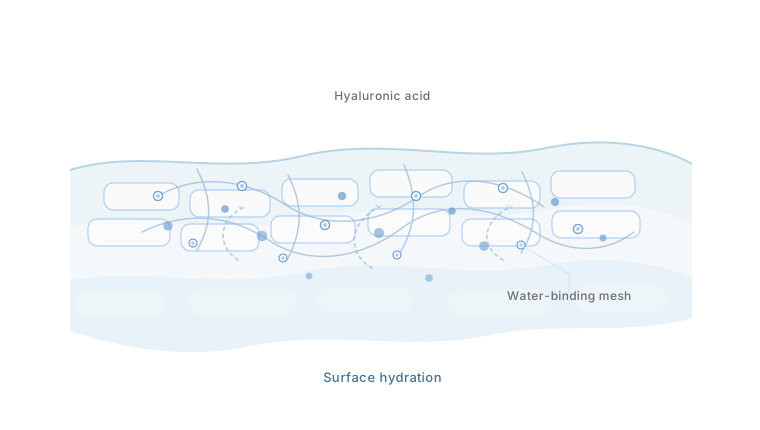
Hyaluronic acid is a naturally occurring sugar molecule found in the skin and connective tissues, used in skincare as a humectant — an ingredient that attracts and holds water. In most formulas it appears as sodium hyaluronate, a smaller, more stable form that sits in the upper barrier and helps the skin feel less tight, less dull, and more comfortable on the surface. Its primary role is surface hydration rather than deep barrier support, which is why it works best alongside other ingredients rather than on its own.
What makes hyaluronic acid distinctive is its capacity to hold significantly more than its own weight in water — a property that has made it famous in skincare marketing. But the more important thing to understand is that hyaluronic acid comes in different molecular weights, and different weights do different things. Higher-weight forms tend to sit on the surface, holding water at the top of the skin for a plumping, smoothing effect. Lower-weight and hydrolysed forms can sit slightly deeper in the outer barrier for a more extended hydrated feel.
This is why you will see products marketed as using ‘multi-weight’ or ‘three-weight’ hyaluronic acid. The claim is not always meaningful in practice — formulation quality matters more than weight count — but it reflects a genuine principle: different forms of hyaluronic acid play slightly different roles, and a well-built formula uses that variety thoughtfully.
For sensitive skin, the most important thing to understand is that hyaluronic acid is almost always a support ingredient, not a complete barrier solution. It pairs well with broader hydrators like glycerin and with lipids like ceramides and squalane, which hold the water in once hyaluronic acid has done its part.
Hyaluronic acid as a water-binding mesh
Common names on labels
This is where INCI literacy really matters. Hyaluronic acid rarely appears under that exact name in a formula — it travels under several related names, and recognising them is one of the most useful label-reading skills for anyone trying to evaluate a hydrating product. Here is what to look for:
- Sodium Hyaluronate — the most common form, stable and widely used
- Hydrolysed Sodium Hyaluronate — a smaller-weight version often included for a more extended hydrated feel
- Sodium Hyaluronate Crosspolymer — a modified form that can sit on the skin surface for longer
- Hyaluronic Acid — the raw ingredient name, sometimes used directly
- Sodium Acetylated Hyaluronate — an enhanced form designed for improved skin affinity
- Potassium Hyaluronate — a less common variant with similar humectant properties
Seeing any of these on an INCI list means the formula contains a form of hyaluronic acid. A well-built hydrating product will often contain two or three of them together.
Why hyaluronic acid matters for sensitive and reactive skin
Surface dehydration is one of the most common underlying causes of that tight, uncomfortable, slightly dull-looking state that reactive skin often finds itself in. It is not the same as dryness — dehydrated skin can even feel oily — and it is not the same as a compromised barrier. It is specifically a water shortage in the outermost layers of the skin, and it is exactly what hyaluronic acid was made to address.
The Hyaluronic Acid Family is especially useful when skin feels:
- dull or lacklustre on the surface
- tight after cleansing but not flaky
- surface-dehydrated — fine lines that disappear when moisturiser is applied
- oily yet paradoxically short on water
1. Fast relief for surface dehydration
When the outermost layer of the skin is dehydrated, it can feel less smooth, less supple, and slightly uncomfortable through the day. Hyaluronic acid addresses that quickly — often visibly within minutes — which is one reason it remains so popular in serums and lighter creams. That fast-acting surface effect is genuine, even if it is sometimes oversold.
2. Particularly useful in lighter routines
Not every sensitive-skin user wants or needs a rich barrier cream at every step. Hyaluronic acid earns its place in lighter hydrating products where the routine needs to stay fresh, easy to layer, and comfortable under moisturiser or SPF — or in warmer months when heavier textures feel wrong.
3. A strong partner to barrier ingredients
Hyaluronic acid works best when it is part of a system. In a formula that also contains glycerin, ceramides, or squalane, hyaluronic acid carries the surface hydration while other ingredients handle the deeper barrier work. This is usually where we see it doing its best work — inside a balanced formula, not positioned as the whole answer.
What hyaluronic acid cannot do
This is where many hyaluronic acid products go wrong, and where readers with reactive skin are most often misled.
Hyaluronic acid is a humectant, which means it binds water in the upper skin layers. But water-binding is only useful if the formula or routine also helps keep that water in place. Used on its own — particularly in low-humidity environments, air-conditioned offices, or cold winter air — a thin hyaluronic acid serum may feel tight, tacky, or insufficient because it binds water but does not seal it in.
The practical solution is simple: hyaluronic acid usually works best when it is applied to slightly damp skin and followed with a moisturiser or emollient. Layered properly, it works well as a hydration support step, not as a complete barrier solution.
Hyaluronic acid also cannot repair a compromised barrier. If the underlying barrier is damaged — whether from over-exfoliation, harsh products, or a genuine skin condition — hyaluronic acid may briefly make the skin feel better, but the discomfort will return because the root issue has not been addressed. Barrier repair requires ceramides, cholesterol, fatty acids, and time. Hyaluronic acid is not a substitute for any of those.
And finally, hyaluronic acid does not reduce reactivity on its own. Marketing sometimes suggests that ‘deeply hydrated’ skin is automatically calmer skin, which is partly true — dehydrated skin is often more reactive — but calming reactive skin requires ingredients specifically for that job, such as centella, oat, or ectoin. Hyaluronic acid can be part of the supporting cast, but not the lead.
Is hyaluronic acid good for sensitive skin? The Clarity Verdict
The Hyaluronic Acid Family earns its place in the Green List because it is useful for surface hydration and short-term comfort. It can make the skin feel fresher and less tense, especially when dehydration is part of the picture — and for most reactive-skin users, some form of hyaluronic acid is likely to be in the rotation.
But it is best understood as a hydration layer, not a complete barrier strategy. We favour it most in supportive serums, lighter moisturisers, and formulas where other ingredients — glycerin, ceramides, squalane, panthenol — carry the deeper barrier work. When hyaluronic acid is the main event, the product usually underperforms for reactive skin. When it is a well-placed team player, it is one of the most useful ingredients in the library.
How to use hyaluronic acid
Best For
- Dehydrated skin
- Tight, dull skin
- Surface dehydration lines
- Oily-dehydrated skin
Use When
- Morning and night
- After cleansing
- On slightly damp skin
- Before creams and SPF
Products featuring hyaluronic acid
Our ingredient-led product recommendations are being prepared and will be added soon.