
Shea butter
A naturally rich, plant-derived emollient for very dry and weather-stressed skin.
Shea butter is probably on the INCI list of the last five moisturisers you picked up in a pharmacy. It is everywhere — marketed as luxurious, nourishing, and natural — which makes it hard to tell whether it deserves the attention or whether its presence actually means anything. For reactive skin, the answer is ‘it depends on the formula, the format, and what your skin actually needs’ — which is not the story beauty marketing tends to tell.
On this page
The Clarity Summary
Shea butter is one of the most familiar names in skincare and one of the more honestly complicated ones to evaluate. It is a useful emollient for very dry, chapped, or weather-stressed skin — but it is also one of the most over-claimed ingredients in beauty marketing, and its suitability depends heavily on the product format and the rest of the formula.
For Skincare Clarity, shea butter is a Green List ingredient with caveats. When it appears in a well-formulated recovery balm or winter moisturiser, it does real work. When it appears as a marketing word on an otherwise thin formula, it does almost nothing.
What is shea butter?
Shea butter is a plant-derived fat extracted from the nuts of the shea tree (Vitellaria paradoxa), native to West Africa. On INCI lists it appears as Butyrospermum Parkii Butter, and sometimes in modified forms such as Shea Butter Unsaponifiables or Hydrogenated Shea Butter. It is solid at room temperature, melts readily on contact with skin, and has been used in traditional skincare and food preparation for centuries.
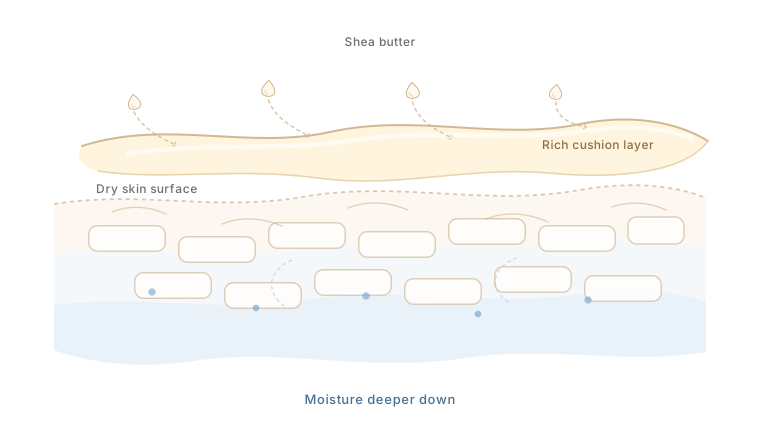
Chemically, shea butter is rich in fatty acids (primarily oleic, stearic, linoleic, and palmitic), along with small amounts of naturally occurring vitamins and phytosterols. This composition is what gives it its characteristic protective, cushioning feel on the skin and its ability to form a soft occlusive layer that slows water loss from the barrier.
There are a few distinctions worth knowing. Refined shea butter is the most common form in commercial skincare — it is stable, consistent, and has a neutral scent. Unrefined shea butter retains more of its naturally occurring compounds but also carries its own natural odour, which not everyone tolerates in a finished product. Some formulas use shea butter unsaponifiables, a fraction of the butter isolated for its higher concentration of protective compounds. All three are legitimate; none is automatically superior.
Shea butter as a rich emollient cushion
Why shea butter matters for sensitive and reactive skin
Reactive skin often needs more than a standard moisturiser during specific windows — deep winter, after a long flight, during a flare, on chapped patches that will not settle. These are the moments where a richer, protective ingredient earns its place, and where shea butter does genuine work that lighter emollients like squalane cannot quite match.
Shea butter is especially useful when skin feels:
- chapped, weather-beaten, or wind-stressed
- persistently dry in a way that lighter products cannot reach
- in need of cushioning protection rather than active treatment
- vulnerable to environmental stress during colder or drier months
The strongest way to think about shea butter is as a protective comfort ingredient, not a hero active. It does not transform the skin. It does not repair the barrier in a structural way. What it does is make very dry, exposed skin feel immediately more comfortable and provide a soft protective layer while other ingredients do their deeper work underneath.
That framing matters because shea butter is often marketed with language — ‘healing’, ‘restoring’, ‘rejuvenating’ — that oversells what an emollient can actually do. Its real value is simpler and more practical: it is one of the most pleasant, well-tolerated cushioning lipids available, and it sits naturally inside recovery-focused formulas alongside barrier ingredients like ceramides, cholesterol, and panthenol.
What to expect realistically
Shea butter is useful in specific scenarios and overrated in others. A few things worth being honest about.
The format changes everything. Shea butter in a balanced recovery cream is an asset. Shea butter as a raw, unrefined butter slathered onto sensitive facial skin often is not — it can feel heavy, sit on the surface without absorbing, and occasionally trigger breakouts in congestion-prone users. The same ingredient delivers very different results depending on how it has been formulated.
It is not ideal for every skin type. Oily, combination, or blemish-prone reactive skin can find shea butter too rich, particularly in the higher concentrations found in pure butters or heavier balms. If your skin tends to feel coated or congested after rich creams, shea butter is usually part of the reason. This is not a fault of the ingredient — it is simply not right for every context.
Although shea comes from a nut, refined shea butter is generally considered low allergy risk for people with peanut or tree-nut allergy because the finished butter contains very little protein. Known shea sensitivity is different: if you have reacted to shea-containing products before, treat it like any other personal trigger and patch test carefully.
‘Shea butter’ on a label tells you very little about quantity. Because the word carries marketing weight, some products list shea butter prominently even when only trace amounts are present. The useful signal is where shea butter sits on the INCI list. If it is in the first five to eight ingredients of a rich cream or balm, it is doing genuine work. If it is near the bottom of the list in a lightweight lotion, its inclusion is largely cosmetic.
And finally, shea butter’s reputation as a ‘healing’ ingredient is overstated. It is soothing in the way any good emollient is soothing — it softens the skin surface and helps reduce moisture loss, which makes uncomfortable skin feel better. But it does not have the clinical evidence base that ingredients like panthenol or centella have for supporting skin recovery. Expect comfort and protection, not repair.
Is shea butter good for sensitive skin? The Clarity Verdict
Seeing shea butter on an INCI list usually tells us something useful about the product’s intent — it suggests the formula is aimed at dry, chapped, or weather-stressed skin rather than at lightweight daily use. But it tells us far less about formula quality in isolation than many beauty articles suggest.
The honest read: shea butter is a good ingredient in the right product and a near-irrelevance in the wrong one. When you see it in a winter-focused moisturiser, a recovery balm, or a rich body or hand cream, it is often doing real protective work. When you see it used as a marketing word on a product that does not otherwise read as barrier-supportive, it is more likely decorative than functional. As with most ingredients in this library, the formula around it matters more than the name itself.
How to use shea butter
Best For
- Very dry skin
- Chapped skin
- Winter protection
- Mature sensitive skin
Use When
- Primarily in the evening
- During winter
- In low-humidity phases
- On dry patches
Products featuring shea butter
Our ingredient-led product recommendations are being prepared and will be added soon.