
Adjust for the season
Winter skincare for sensitive skin: what to change
How to adjust cleansing, moisturising and actives when cold weather and central heating leave skin tight and reactive.
On this page
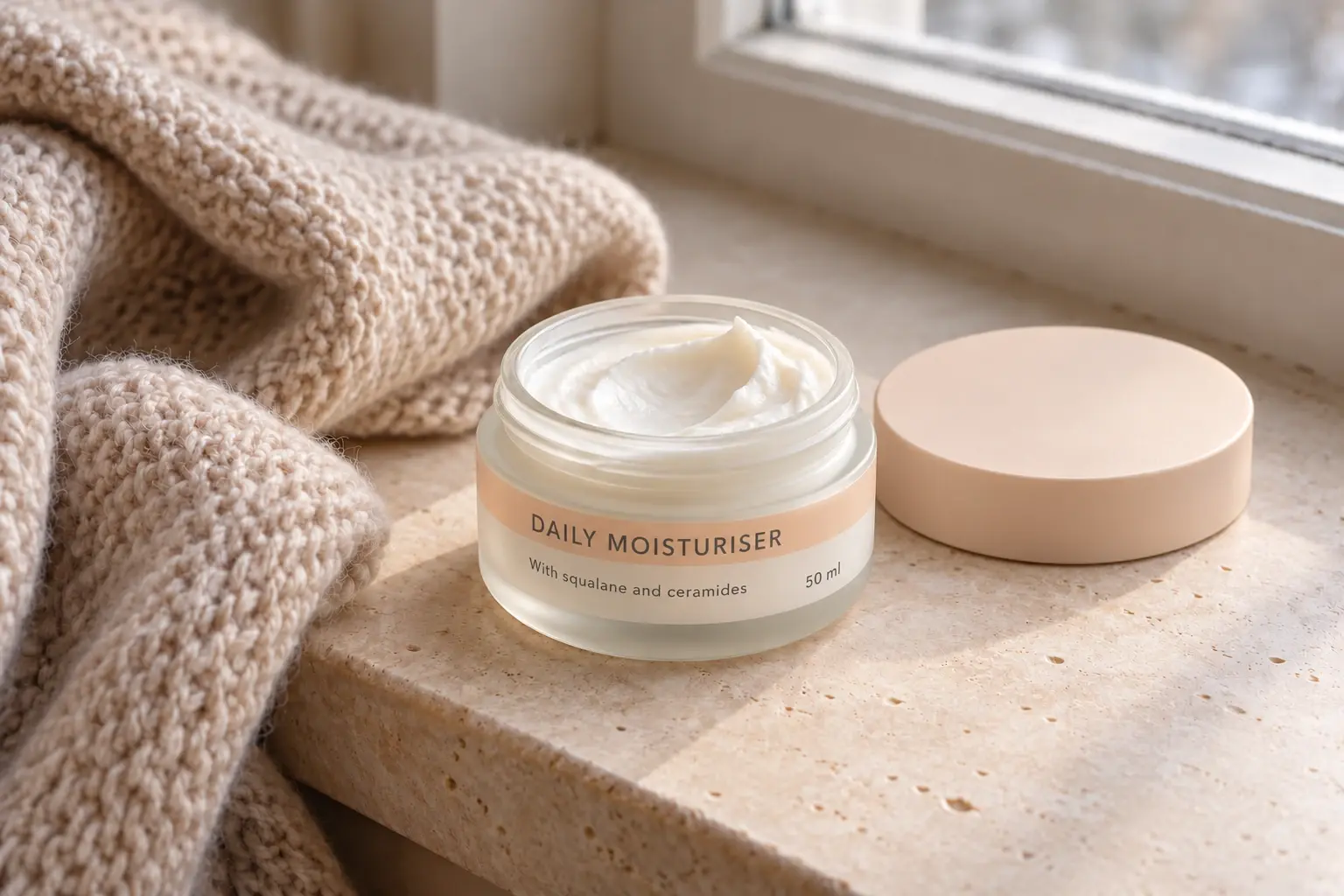
If your skin copes well enough from spring to autumn, then turns tight, flaky or quick to sting once the heating goes on, the answer is rarely a new routine. Winter changes the conditions your skin works in. A few adjustments to how you wash, what you put on afterwards and how often you use stronger products usually do more than another purchase. This guide covers what to change, what to leave alone and when winter dryness needs more than skincare.
Clarity Summary
- Wash more gently. Shorter, warm rather than hot, and only as much cleanser as you need.
- Go one step richer. A cream instead of a gel, or a balm or oil over your moisturiser at night.
- Use non-prescribed actives less often. Over-the-counter acids and retinoids can wait until your skin settles. Ask your prescriber before changing anything prescribed.
- Keep it short. Change one thing at a time, and get advice if skin cracks, bleeds or won’t settle.
Why winter is harder on sensitive skin
Cold outdoor air holds little moisture, and heating dries indoor air further. A review of the research found that low humidity and low temperatures both reduce the skin barrier’s function and can make skin more reactive to irritants. Cold, dry weather is also linked to more flares in people with atopic dermatitis (Engebretsen et al., 2016). Wind and long, hot showers add to the strain.
The result is the familiar winter pattern: skin that feels tight after washing, rough patches on the cheeks or around the nose, and products that never used to bother you starting to sting. If that sounds like a barrier under pressure, our guide to a damaged skin barrier explains what is happening underneath.
Wash more gently
If your face feels tight after washing, cleansing is usually the first thing to change.
- Keep showers short and warm, not hot. The American Academy of Dermatology suggests five to ten minutes with warm water, then patting skin dry rather than rubbing (AAD, dry skin tips).
- Use just enough cleanser to remove sunscreen, make-up and the day’s grime. Heavy lather isn’t a sign of a better clean.
- Notice how your face feels afterwards. Tightness straight after washing is a useful signal. If a gel or foaming wash leaves you feeling that way in winter, a cream or milk cleanser may suit you better until spring.
- Consider whether you need cleanser twice a day. Many people with dry, reactive skin find a rinse with water is enough in the morning.
Our guide to choosing a gentle cleanser compares gel, cream and balm formats. Our screened cleansers exclude SLS and SLES and are all fragrance-free.
Move one step richer
You don’t have to replace your moisturiser for winter, but you may need it to do more. Creams and ointments generally hold in more moisture than lotions, and dermatologists point to ingredients such as glycerin, shea butter, jojoba oil, dimethicone and petrolatum for dry skin (AAD, dry skin tips).
A few ways to step up without starting again:
- Swap formats for the season, from a gel or fluid to a cream, if your skin feels tight by midday.
- Keep your lighter moisturiser for the day and use something richer at night.
- Apply moisturiser to skin that’s still slightly damp, straight after washing. That helps any occlusive ingredients, such as petrolatum or dimethicone, hold water in (Purnamawati et al., 2017).
For choosing between gels, fluids and creams by what’s in them, see how to choose a moisturiser. The roles to look for are a humectant such as glycerin to hold water, and emollients such as squalane or shea butter to soften and slow water loss.
Where a balm or oil fits
Sometimes your usual moisturiser is fine across most of your face, but dry patches, wind-chapped cheeks or the skin around your nose need more. That’s where a richer treatment or a facial oil can sit on top, usually at night, rather than replacing everything.
Two screened products show different ways of doing this:
Byoma Barrier+ Treatment
Byoma Barrier+ Treatment is what Byoma calls a leave-on treatment, and its ingredient list reads like a rich cream. After glycerin and other humectants come emollient esters, silicones and shea butter, with squalane and avocado oil a little further on. Ectoin, sphingolipids and Ceramide NP also appear, further down the list, so they’re present, but the label can’t tell you how much. It suits days when your usual cream isn’t quite enough across larger areas.
Biossance 100% Squalane Oil
Biossance 100% Squalane Oil contains one ingredient: squalane. A few drops can go over your moisturiser as a final layer, or be mixed into it. Because there’s only one ingredient, it’s also easy to judge whether it suits you. It’s the simpler choice if you only want to add an emollient layer, not a second cream.
Both passed our screening when we rechecked their UK ingredient lists in October 2026. Individual tolerance still varies, and the recovery balms and oils collection has more options.
Ease off strong actives
Exfoliating acids and retinoids ask more of the skin barrier, and winter already asks a lot. The AAD suggests using acids such as glycolic or salicylic acid, and retinol, less often or at a lower strength during winter (AAD, winter skin survival kit).
If you’ve been using an over-the-counter exfoliant several times a week, dropping to once or twice, or pausing until your skin settles, costs you very little.
That’s seasonal advice. Separately, our Red List excludes glycolic acid above 5% and salicylic acid above 2% all year round, so stronger exfoliants don’t appear in our catalogue in any season.
If a retinoid or another treatment has been prescribed for you, don’t stop or change it on your own. Ask your prescriber how to adjust it for winter.
Indoor air and everyday habits
A few habits outside your skincare also make a difference:
- Heating: a humidifier in the bedroom can add moisture to the air overnight. The AAD suggests one for dry skin and stresses cleaning it regularly (AAD, dry skin tips). It’s optional, not essential.
- Towels and scrubbing: pat dry, and leave scrubs and cleansing brushes alone while skin is tight or flaky.
- Lips and hands: these dry out first. A plain, fragrance-free balm and a hand cream after washing your hands are worth keeping to hand.
Keep sunscreen in the routine
UV levels in the UK are much lower in winter than in summer, but they’re not zero, and winter sun, snow and travel can all raise your exposure. The AAD recommends sunscreen year-round on exposed skin, and notes that cream sunscreens are more moisturising than lotions or sprays (AAD, winter skin survival kit).
If you use a daily sunscreen, there’s no need to drop it for winter. Apply it as the last step of your morning skincare, over your moisturiser. Our guide to skincare order explains why. Our screened SPF selection is fragrance-free.
When winter dryness needs more than skincare
Speak to a pharmacist or GP if:
- skin is cracked, bleeding or painful
- you have an itchy rash that’s spreading or keeps coming back
- dryness hasn’t improved after simplifying your routine and moisturising regularly
- you think it might be eczema, psoriasis or another skin condition
If a product burns or stings, stop using it. Winter skincare can make dry skin more comfortable, but it isn’t a substitute for assessment when something more is going on.
Your winter checklist
- Is my shower short, and warm rather than hot?
- Does my face feel tight after washing? If so, try a gentler cleanser or cleanse less often.
- Is my moisturiser rich enough for the season, applied to slightly damp skin?
- Do dry patches need a balm or oil on top at night?
- Have I cut back over-the-counter exfoliants and retinoids until my skin settles, without changing anything prescribed?
- Am I still using sunscreen when I’m outside?
Sources
- Engebretsen KA, Johansen JD, Kezic S, Linneberg A, Thyssen JP (2016). The effect of environmental humidity and temperature on skin barrier function and dermatitis. Journal of the European Academy of Dermatology and Venereology, 30(2), 223–249. DOI: 10.1111/jdv.13301.
- Purnamawati S, Indrastuti N, Danarti R, Saefudin T (2017). The role of moisturizers in addressing various kinds of dermatitis: a review. Clinical Medicine & Research, 15(3–4), 75–87. DOI: 10.3121/cmr.2017.1363.
- American Academy of Dermatology. Dermatologists’ top tips for relieving dry skin. Updated 2 January 2026.
- American Academy of Dermatology. Your winter skin survival kit. Updated 27 May 2021.
- Product ingredient lists rechecked 22 October 2026: Byoma Barrier+ Treatment, Cult Beauty; Biossance 100% Squalane Oil, Cult Beauty, also listed as squalane only by Sephora UK.
Product ingredient lists and formats come from the linked Skincare Clarity assessments. These are screening examples, not evidence that a named finished product achieves a clinical result.