
Read the label
How to read a skincare ingredient list
Ingredient order, unfamiliar names and what a list can tell you, with two real UK examples.
On this page
The ingredient list uses INCI names – the International Nomenclature of Cosmetic Ingredients – to identify what’s in a skincare product. Once you recognise the naming patterns and ordering rules, it becomes easier to read. This guide walks through the rules, then reads two real UK lists the way we read them ourselves.
Clarity Summary
- How the order works. Ingredients are listed from most to least by weight down to 1%. Below that, they can appear in any order, and colourants can go at the end.
- What it can’t tell you. The list doesn’t disclose exact amounts or show where the 1% point falls. It can’t tell you how your skin will respond.
- Learn the naming patterns. Latin plant names, slashes and ingredient families help you recognise common ingredients.
- Check your priorities first. Look for your known triggers and ingredients on our Red List. An unfamiliar name isn’t a reason to rule a product out.
Start with the right list
Before reading anything, make sure you’re reading the right version.
- The pack in your hand is the best source. After that, use the brand’s UK website, then a UK retailer’s page.
- Match the version. Formulas change, and UK, EU and US versions of the same product can differ. Check the size and region, and be wary of old screenshots.
- When two sources disagree, the pack wins. Retailer pages occasionally carry an older list, or one for a different version of the product.
The rules that shape the list
In Great Britain, ingredient labelling follows Article 19 of the cosmetics regulation (Regulation 1223/2009). The parts that matter when you’re reading a label:
- Descending order of weight. Ingredients at 1% or more are listed from most to least, by weight when they’re added to the formula.
- The 1% point. Ingredients below 1% can follow in any order. The label doesn’t mark where that point falls, so you can’t compare two low-listed ingredients by position.
- Colourants. These are listed by CI (Colour Index) number and can be placed after the other ingredients in any order. Multi-shade make-up can group them under ‘may contain’ or ‘+/-‘.
- Nanomaterials. These are followed by ‘(nano)’, which you’ll mostly see on mineral sunscreens.
- Fragrance. A scent blend appears as a single word, parfum (or aroma for flavours). Certain fragrance allergens, such as linalool, limonene and geraniol, must also be named separately once they go above a small threshold: 0.001% in leave-on products and 0.01% in rinse-off products (Annex III). Our guide to fragrance-free vs unscented shows how to check a label for scent.
Packs also intended for EU sale may name additional fragrance allergens under the EU’s expanded labelling requirements.
One popular rule of thumb doesn’t hold up: ‘the first five ingredients make up most of the product.’ No rule says that. The order shows ranking, not proportions. Water alone can make up most of a cream, or a serum can have a long run of ingredients at a few per cent each.
Reading the names
INCI names look intimidating, but a few patterns cover most of them.
- Plants use Latin names. Butyrospermum Parkii Butter is shea butter, and Centella Asiatica Leaf Extract is centella, part of our Cica Family.
- Slashes can separate synonyms or translations, as in Aqua / Water / Eau, which is one ingredient; so is ‘Zea Mays Starch / Corn Starch’. Some names contain slashes as part of the name itself, such as Cetyl PEG/PPG-10/1 Dimethicone.
- One ingredient family, several names. Ceramides appear as Ceramide NP, AP or EOP; our damaged skin barrier guide explains why they’re often paired with cholesterol. The Hyaluronic Acid Family usually shows up as Sodium Hyaluronate.
- ‘Alcohol’ isn’t one thing. Cetearyl Alcohol and Cetyl Alcohol are fatty alcohols that soften skin. Alcohol Denat. is a drying solvent. Read the whole name.
- Front-of-pack names often differ from INCI names. ‘Vitamin C’ might appear on the list as Ascorbyl Glucoside or Sodium Ascorbyl Phosphate; see our vitamin C page.
- Asterisks usually point to a brand’s own footnote, such as ‘*organic origin’. Read the footnote; it isn’t part of the regulated list.
Worked example 1: La Roche-Posay Cicaplast Baume B5+
Here’s the full published UK list for Cicaplast Baume B5+, a balm that met our screening criteria when we checked it (La Roche-Posay UK):
Full ingredient list (33 ingredients)
Aqua / Water / Eau ● Hydrogenated Polyisobutene ● Dimethicone ● Glycerin ● Butyrospermum Parkii Butter / Shea Butter ● Panthenol ● Zea Mays Starch / Corn Starch ● Propanediol ● Butylene Glycol ● Cetyl PEG/PPG-10/1 Dimethicone ● Trihydroxystearin ● Centella Asiatica Leaf Extract ● Polymnia Sonchifolia Root Juice ● Zinc Gluconate ● Madecassoside ● Manganese Gluconate ● Alpha-Glucan Oligosaccharide ● Silica ● Aluminium Hydroxide ● Magnesium Sulfate ● Mannose ● Capryloyl Glycine ● Caprylyl Glycol ● Vitreoscilla Ferment ● Citric Acid ● Trisodium Ethylenediamine Disuccinate ● Lactobacillus ● Acetylated Glycol Stearate ● Maltodextrin ● Polyglyceryl-4 Isostearate ● Tocopherol ● Pentaerythrityl Tetra-di-t-butyl Hydroxyhydrocinnamate ● CI 77891 / Titanium Dioxide
An ingredient list, grouped by job
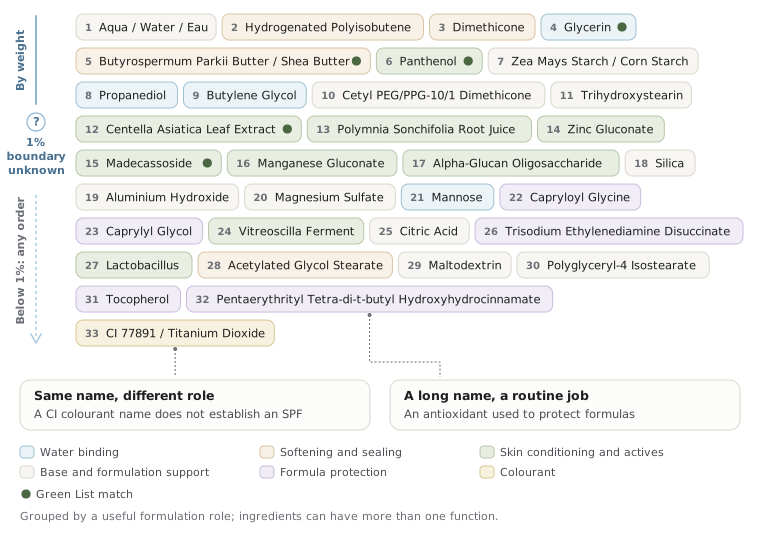
Thirty-three ingredients look like a lot. Grouped by job, they’re much easier to follow:
| On the label | What it is | What the label tells you | What it can’t |
|---|---|---|---|
| Aqua, Hydrogenated Polyisobutene, Dimethicone | The base: water, a light synthetic oil and a silicone | These lead the formula; base ingredients can also soften skin or slow water loss | The exact proportions |
| Glycerin, Propanediol, Butylene Glycol, Mannose | Humectants and solvents | Glycerin is near the top, a good sign for hydration | How much water-binding each adds |
| Shea Butter, Panthenol | An emollient and a comfort ingredient | Both appear in the upper part of the list | The amount of panthenol (but see below) |
| Centella Asiatica Leaf Extract, Madecassoside | Our Cica Family | Both are present | How much of either, or the extract’s strength |
| Zea Mays Starch, Trihydroxystearin, Silica, Magnesium Sulfate, emulsifiers | Base and formulation support | How the balm holds together | Anything about effects on skin |
| Zinc Gluconate, Manganese Gluconate, ferments, other sugars | Skin conditioning and actives | They’re in the formula | Whether they’re at a level that matters |
| Capryloyl Glycine, Caprylyl Glycol, Trisodium Ethylenediamine Disuccinate, Tocopherol, Pentaerythrityl Tetra-di-t-butyl Hydroxyhydrocinnamate | Formula protection: preservation support, a chelator and antioxidants | These ingredients can help support preservation or limit oxidation | How effective the complete preservation system is |
| CI 77891 / Titanium Dioxide | A colourant | It’s in the colourant position at the end | — |
Four things are worth noticing.
Matched to our library. Glycerin, shea butter, panthenol and the Cica Family all appear on our Green List. That’s useful context, but a match count isn’t a quality score.
The Red List check comes back clear. There’s no parfum, no declared fragrance allergens, no Alcohol Denat., and no methylisothiazolinone or parabens. Our methodology explains the full screen.
The same name can do a different job. Titanium dioxide is a mineral UV filter in sunscreens. Here it sits at the end with its CI number in a product with no SPF, so it’s there as a colourant. Read the name in context.
A long name isn’t a warning sign. Pentaerythrityl Tetra-di-t-butyl Hydroxyhydrocinnamate looks alarming, but it’s an antioxidant that stops the oils in the formula going off. Most unfamiliar names have ordinary formulation roles like this.
And one thing the list can’t tell you: amounts. Most ingredient lists don’t disclose individual percentages. Here, La Roche-Posay separately states that the balm contains 5% vitamin B5 (panthenol). That figure comes from the brand, not the list. Nothing on the label tells you how much centella or madecassoside is present.
Worked example 2: a UK brightening serum
This second example is a real UK serum that doesn’t meet our screen. We’ve left the product unnamed so the focus stays on reading the formula. It mixes ingredients we like with ones we screen out. Here’s the full published list, in its original order:
Full ingredient list (33 ingredients)
Aqua / Water ● Glycerin ● Alcohol Denat. ● Dipropylene Glycol ● Butylene Glycol ● Niacinamide ● PEG/PPG/Polybutylene Glycol-8/5/3 Glycerin ● Hydroxyethylpiperazine Ethane Sulfonic Acid ● Isononyl Isononanoate ● Ascorbyl Glucoside ● Citrus Limon Fruit Extract / Lemon Fruit Extract ● Potassium Hydroxide ● 2-Mercaptonicotinoyl Glycine ● Sodium Hyaluronate ● Sodium Thiosulfate ● Silica ● Adenosine ● Phenylethyl Resorcinol ● Ammonium Polyacryloyldimethyl Taurate ● Hydrogenated Lecithin ● Caprylyl Glycol ● Tetrasodium Glutamate Diacetate ● Trisodium Ethylenediamine Disuccinate ● Xanthan Gum ● Tocopheryl Acetate ● Salicylic Acid ● Chlorphenesin ● CI 15510 / Orange 4 ● CI 19140 / Yellow 5 ● Linalool ● Geraniol ● Limonene ● Parfum / Fragrance
An ingredient list, read through our screen
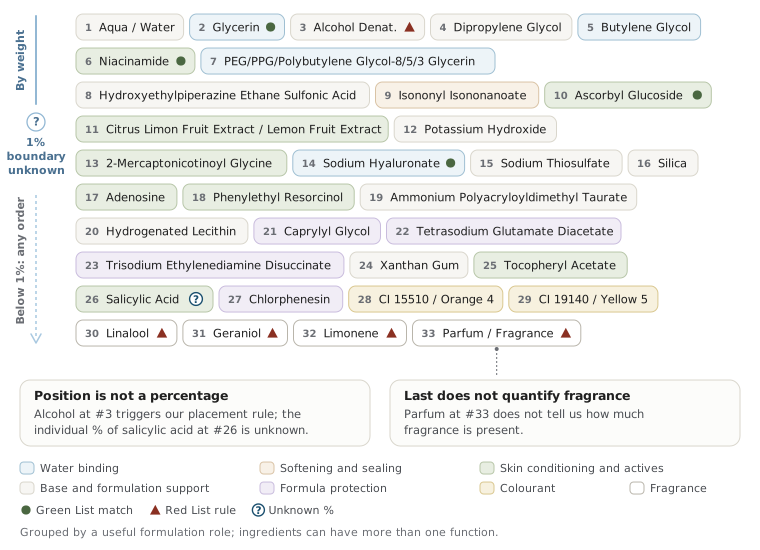
Good ingredients and Red List matches can share a formula. Glycerin, niacinamide, sodium hyaluronate and ascorbyl glucoside (a vitamin C derivative) all match our Green List. Their presence doesn’t cancel out what else is on the list.
Why it doesn’t meet our screen.
- Alcohol Denat. is listed third, straight after water and glycerin. That placement makes it part of the base rather than a minor additive, and placement is exactly what our drying-alcohol rule looks at.
- There’s parfum, plus three declared fragrance allergens.
Being last doesn’t reveal how much fragrance is present. Parfum sits at the very end, after the colourants. Below 1%, ingredients can appear in any order, so last place tells you nothing about the amount. A fragrance at the bottom of the list is still a fragrance.
Blend percentages need careful reading. The brand states a combined 4% for a blend that includes vitamin C, niacinamide and salicylic acid. That isn’t 4% of any one ingredient. Our Red List excludes salicylic acid above 2%, but the list doesn’t show whether it exceeds that limit. We mark that concentration check as unknown. The fragrance and prominent drying alcohol already rule the serum out.
Looking up an unfamiliar name
When a name stops you:
- Check our ingredient library for the Green List and Red List ingredients we cover in depth.
- Search the EU’s CosIng database. It gives the INCI name and the functions an ingredient is listed for, such as ‘emollient’ or ‘antioxidant’. It’s an EU tool and is for information only, but INCI names are shared, so it works for UK labels too.
- Don’t treat unfamiliar as unsafe. Many long chemical names belong to emulsifiers, thickeners and antioxidants doing routine work.
What a label can’t tell you
Even a careful read leaves gaps:
- amounts and ratios, unless the brand declares them separately
- where the 1% point falls
- the grade, source or particle size of an ingredient (apart from ‘(nano)’)
- the formula’s pH
- how well it’s built as a whole
- how your skin will respond
That’s why a screened product is a strong starting point, not a guarantee. Our methodology sets out what a pass does and doesn’t mean.
Your label-reading checklist
- Right list: UK pack or brand page, current version.
- Your triggers first: anything you already know you react to.
- Red List scan: parfum and fragrance allergens, drying alcohols high on the list, and preservatives such as methylisothiazolinone.
- Match names to roles: humectants, emollients, actives, colourants. Use the library for the rest.
- Note what’s unknown, especially percentages, and don’t fill the gaps with guesses.
If you’re choosing a moisturiser, our moisturiser guide puts these skills to work.
Sources
- Regulation (EC) No 1223/2009 on cosmetic products, Article 19 (labelling), as it applies in Great Britain. legislation.gov.uk.
- Regulation (EC) No 1223/2009, Annex III (restricted substances, including the fragrance-allergen labelling conditions), as it applies in Great Britain. legislation.gov.uk.
- European Commission. CosIng: cosmetic ingredient database. Informative only, with no legal value. CosIng.
- European Commission. Fragrance allergens labelling. Explains the expanded EU-market requirements under Regulation (EU) 2023/1545; separate from the Great Britain rule cited above.
- Product ingredient lists: La Roche-Posay UK (Cicaplast Baume B5+), checked 12 October 2026; a UK brand’s published list (example 2), checked again 14 October 2026.